
Heat Shrink Butt Connectors: A Procurement Guide for OEMs and Distributors
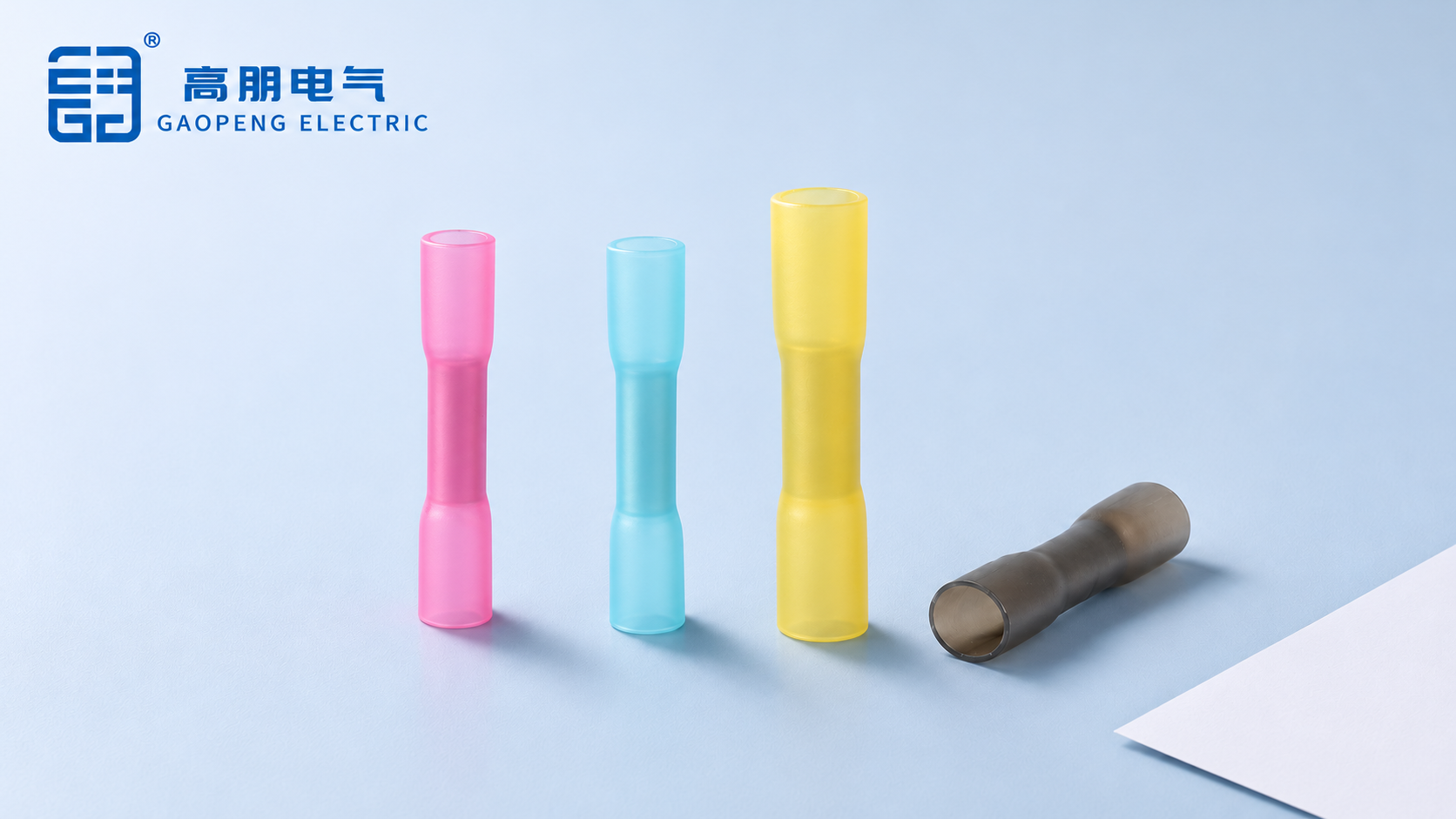
Buy heat shrink butt connectors against a two-ended wire specification, not sleeve color alone. The buyer needs to define the conductor and insulation at each end, the barrel fit, the crimping method and the required sealing performance. Only then can two quotations describe a comparable splice.
Gaopeng’s heat-shrink butt-connector range lists a copper barrel inside a polyolefin dual-wall sleeve with internal hot-melt adhesive. That construction identifies the product family. The exact reference, dimensional fit and finished-joint requirements still belong in the purchase specification.
Specify both wires for heat shrink butt connectors
A butt splice connects two wire ends, and those ends may differ. Record the conductor metal, cross-section or AWG and strand construction on each side. Include insulation outside diameter separately: equal copper sections can have different insulation diameters, so a barrel selection does not by itself settle the sleeve’s fit.
If the wires differ in size, ask the supplier to confirm an approved connector arrangement for that exact pair. Do not assume a color-coded sleeve accepts every combination within a broad nominal range. Request the applicable drawing and application instructions for the proposed reference.
Installation access also affects the purchase. The specified tool and die must reach the intended crimp area without damaging the sleeve. The assembly team needs the connector’s instructions and the appropriate tooling reference, rather than a generic instruction to use any crimping pliers.
Compare the crimp connection and the sealing requirement separately
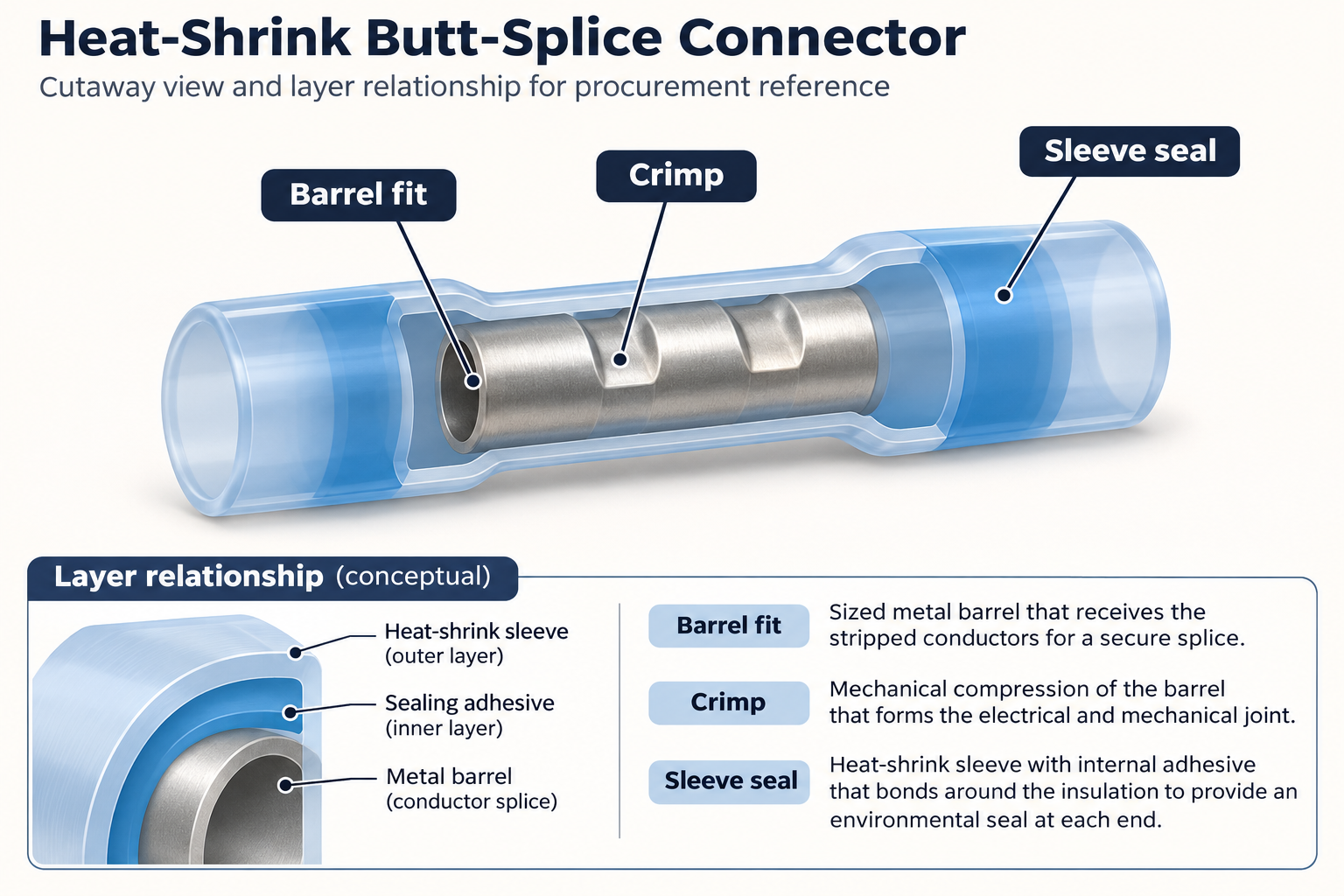
The barrel provides the crimped conductor connection. The sleeve and adhesive address the surrounding insulation and sealing requirement. A neatly recovered sleeve does not establish that the conductor connection meets its acceptance criteria. Likewise, a satisfactory crimp does not prove a finished assembly’s environmental rating.
State the exposure the completed splice must withstand: location, moisture, fluids, temperature range and mechanical movement, as applicable. Ask what evidence supports the exact offered product and assembly. A rating printed on another manufacturer’s tubing or connector cannot be assigned to this splice.
A useful comparison sheet separates declared construction from the evidence needed for acceptance:
| Order requirement | Supplier response to request | What to verify |
|---|---|---|
| Wire at end A and end B | Accepted metal, size, construction and insulation diameter for each end | Both actual production wires are covered |
| Barrel and crimp | Drawing, tool/die reference and application instructions | The approved process matches the offered connector |
| Sleeve and adhesive | Construction and compatibility information | Fit and intended exposure are addressed |
| Finished-joint requirement | Applicable evidence and agreed sample checks | Evidence covers the requested assembly and conditions |
| Packing and identification | Quantity by reference and batch identification | Similar-looking sizes remain distinguishable |
Approve samples made with the intended production wires
Loose samples help check dimensions and product identity. Assembled samples address a different question: whether the proposed connector and process meet the agreed requirements with the buyer’s actual wires. Keep those approvals distinct so an accepted loose sample is not mistaken for a qualified splice process.
Agree the sample evaluation before ordering the bulk lot. The record should identify the connector reference, wire pair, tool and die, application instructions and the required inspections or tests. Set any electrical, mechanical and sealing criteria with the responsible engineering team; this guide does not supply universal test values.
Retain the approved sample or its controlled record. Photograph the identification and relevant features, but do not use appearance alone as evidence for an electrical or environmental requirement. If a supplier proposes a changed sleeve, barrel or size range, assess that change against the approved assembly before accepting it as equivalent.
Normalize the quotation by reference and packing level
Request a separate order line for each connector reference and quantity. If buying an assortment, list the count of each size as well as the total kit count. A box price cannot be compared fairly when one offer has a different size mix or an unspecified piece count.
Include the delivery destination, required documents, packing format and labeling requirements. Ask the supplier to confirm price basis, minimum order quantity, sample terms and delivery schedule in the quotation. These are transaction-specific terms, not fixed properties of the product family.
For repeat orders, refer to the accepted drawing revision and sample record. State how substitutions and changes will be approved. The purchasing team can then distinguish a routine replenishment from a proposal that changes the conductor fit, assembly process or documentation.
Send a complete splice requirement for quotation
A useful inquiry identifies the wire at both ends, the intended environment, the desired connector size mix and quantities. Attach the drawing or dimensions that control fit, and identify any mandatory finished-joint or documentation requirement. Ask for the exact proposed references and the information still needed to confirm them.
This gives the supplier a concrete specification to answer. It also gives receiving and assembly teams an agreed basis for checking the delivered connectors, rather than leaving them to interpret an order described only as “waterproof butt connectors.”