
Stainless Steel Cable Ties: Specify Grade, Geometry and Acceptance Before Ordering

A purchase specification for stainless steel cable ties needs more than “304” or “316.” It should identify the material, strap geometry, locking arrangement and conditions under which the finished tie will be accepted. The material designation answers only one part of that requirement.
Gaopeng’s self-locking stainless-steel tie listing includes 304 and 316 options. For a useful quotation, connect the requested grade to the actual strap width, length, bundle dimensions and quantity. Ask for the proposed reference and supporting information rather than treating the grade as a complete product specification.
Define exposure before choosing stainless steel cable ties
Stainless-steel selection depends on the environment as well as the alloy designation. Moisture, chloride exposure, deposits and crevices can affect corrosion behavior. A grade name alone does not establish unlimited service life or suitability for every coastal, chemical or outdoor location.
The inquiry should describe where the tie will be used and what it will contact. Include relevant fluids, cleaning chemicals, temperature conditions and moisture exposure. Identify the required material documentation and whether it must be linked to a particular delivered lot.
Keep any environmental or fire-performance requirement separate and explicit. If the project requires a particular approval, ask for evidence covering the exact supplied product and intended use. A general statement about stainless steel is not a finished cable-tie approval.
Turn “same size” into a dimensional comparison
Two ties with the same nominal length may differ in width, thickness, usable bundle range or locking-head geometry. Request a drawing that identifies the dimensions controlling the application. Confirm the required bundle range with the supplier instead of calculating it from total strap length alone.
Check available clearance around the locking head and the strap’s contact with the bundle. Where cable insulation or a finished surface needs protection, identify the required interface arrangement for engineering review. Do not infer that an uncoated metal strap is suitable for every surface simply because its material resists corrosion.
Also identify the intended application tool, if one is required by the assembly process. The tool and any tension-setting instructions should match the proposed tie. A product photograph cannot establish the correct setting or the holding performance of the completed loop.
Ask what each performance statement actually covers
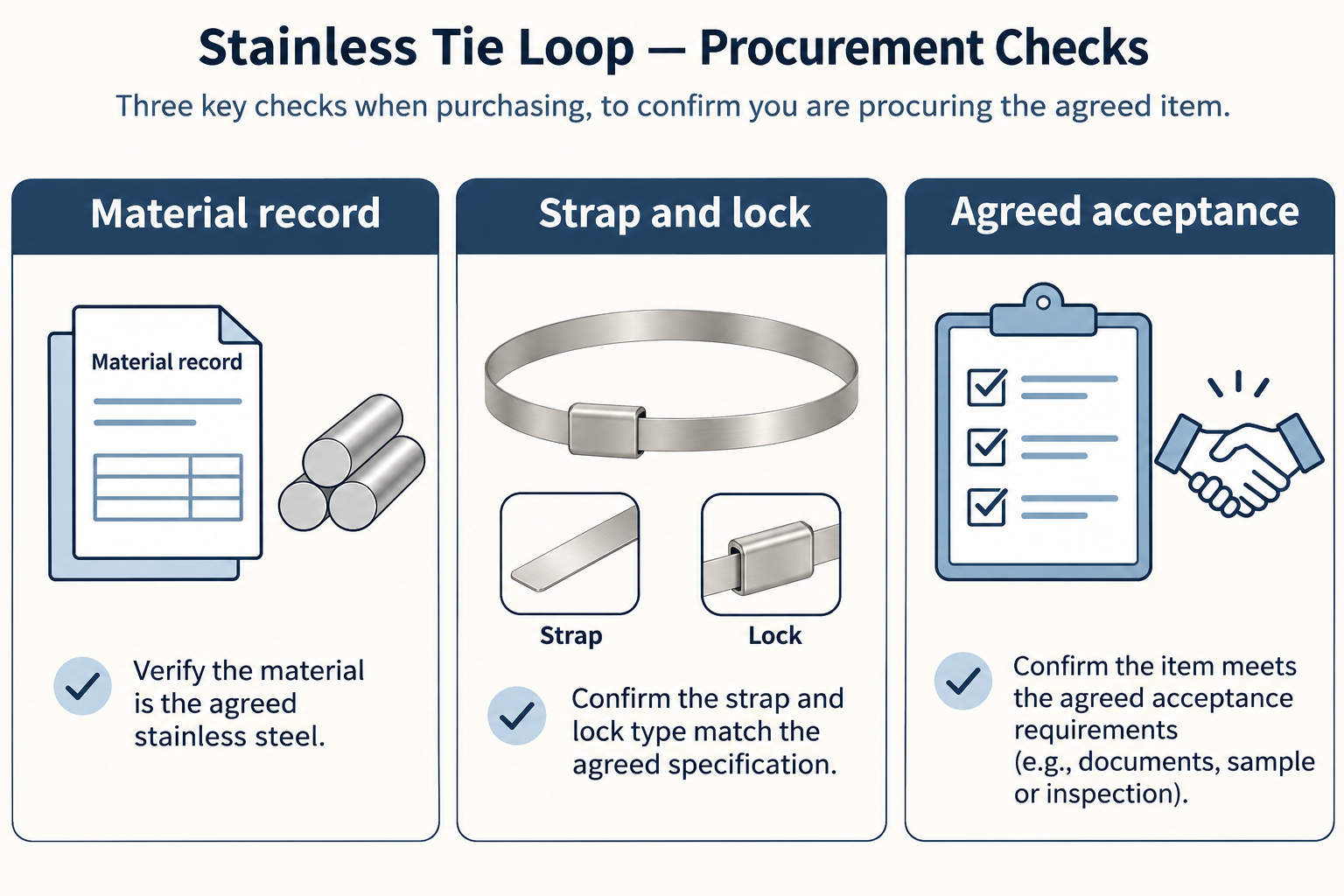
A material record identifies the stated metal. It does not, by itself, establish the locking head’s performance or the assembled tie’s behavior. If a quotation includes a force value, request its test method, specimen configuration and acceptance basis.
Record whether a stated result describes the strap, the lock or the complete installed loop. Ask for the conditions and exact reference covered. Different test descriptions should remain separate until the engineering team determines whether they answer the same requirement.
The following worksheet makes that distinction visible during supplier comparison:
| Requirement | Evidence to request | Buyer’s acceptance question |
|---|---|---|
| Material grade | Agreed material record and lot linkage | Does it identify the material actually offered? |
| Strap and head | Controlled drawing and dimensional limits | Does the complete tie fit the bundle and available space? |
| Locking performance | Applicable method and stated conditions | Does the evidence cover the required complete-tie behavior? |
| Exposure requirement | Product-specific supporting evidence | Does it address the intended environment? |
| Supply identity | Reference, packing and batch labeling | Can receiving distinguish the accepted variants? |
Agree the sample record before placing the bulk order
Use samples to resolve dimensional fit and handling questions with the intended bundle arrangement. Identify the sample reference, drawing revision, material declaration and application method. An unrecorded sample makes later comparisons difficult, even when the buyer remembers approving its appearance.
The parties should agree the inspections or tests needed for the application, including any sampling plan. This guide does not assign a universal pull force or acceptance threshold. Those requirements must come from the project specification and the evidence applicable to the proposed tie.
Retain an approved sample or a controlled record of its relevant features. State which changes require approval, such as strap dimensions, locking construction, material or surface condition. A supplier’s proposed alternative can then be evaluated against a known requirement.
Make the order lines usable for repeat purchasing
Separate quantities by grade and full size reference. State pieces per pack, labeling, destination and required documents. Confirm the quoted price basis, minimum quantity and delivery schedule for that particular order; none follows automatically from selecting 304 or 316.
For replenishment, cite the accepted reference and drawing revision instead of copying only the previous invoice’s short description. Require confirmation of any substitution before shipment. This preserves the dimensional, material and acceptance decisions already made, while allowing the supplier to identify a proposed change clearly.