
Wire Ferrules Procurement Guide: Cross-Section, Sleeve Length and Terminal Fit

Specify wire ferrules by conductor cross-section, metal sleeve length and receiving-terminal requirements. Collar color is useful for identification within an agreed system, but it does not replace those details. A purchase described only as “blue ferrules” leaves important fit decisions unresolved.
For a repeatable order, identify the conductor construction, single- or twin-wire arrangement, full ferrule reference and accepted crimping method. Keep the metal sleeve length separate from the overall length, which includes the collar. These distinctions matter when buyers compare alternatives that look similar in a catalog.
Wire ferrules with the same wire size can have different sleeve lengths
Gaopeng’s E-series cord-end ferrule table lists copper ferrules with separate dimensions for metal sleeve length, F, and overall length, L. Two entries illustrate why a conductor-size description alone is incomplete.
| Reference | Listed conductor section | Metal sleeve F | Overall length L |
|---|---|---|---|
| E1508 | 1.5 mm² | 8.0 mm | 15.2 mm |
| E1512 | 1.5 mm² | 12.0 mm | 19.2 mm |
Both entries list the same conductor section, yet their metal sleeves differ by 4 mm. Substituting one for the other changes the part presented to the receiving terminal. The longer version is not automatically better: the appropriate length depends on the terminal’s accepted conductor preparation and engagement requirements.
These catalog dimensions are not universal wire-stripping instructions. Ask for the application information for the selected ferrule and terminal combination. Production preparation should follow that information rather than use overall ferrule length as a stripping dimension.
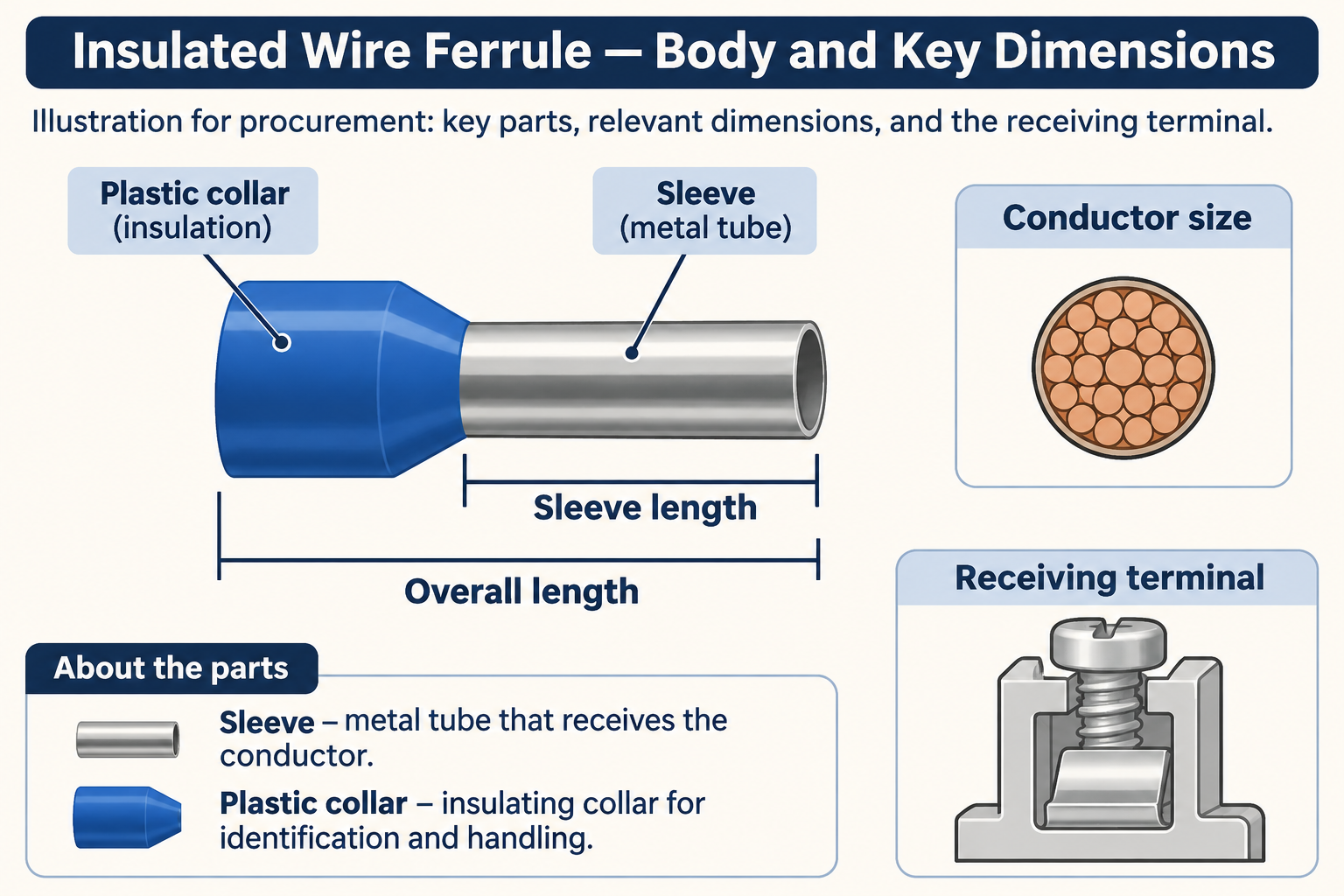
Confirm the terminal accepts the proposed ferruled conductor
The receiving terminal is part of the selection. Identify its reference and the conductor types it accepts, including its requirements for ferrules. A ferrule that matches the wire section can still be unsuitable for a particular terminal’s entry or clamping arrangement.
Ask the assembly team to confirm the completed crimp profile and dimensions against the terminal instructions. A tooling recommendation should identify the proposed ferrule family, wire construction and crimp form. “Universal ferrule tool” is not enough information to settle compatibility.
For a twin-wire termination, specify the two conductors and the intended terminal arrangement explicitly. A twin ferrule is a separate product choice; do not assume a larger single ferrule provides an equivalent two-wire connection. Confirm that the receiving terminal accepts the intended arrangement before freezing the order.
Record color as an additional identifier
Color conventions can vary by product system and market. State the conductor size and full product reference alongside any required collar color. If the assembly line uses color for picking or inspection, tell the supplier which convention or approved sample controls that requirement.
Also distinguish insulated and uninsulated versions, single and twin configurations, and the sleeve lengths needed at each terminal. A distributor’s assortment should list the count of each exact variant. A total piece count does not reveal whether the assortment contains the sizes the customer actually uses.
Evaluate the assembled sample, not just the loose ferrule
Loose-part inspection can check reference, dimensions and visible condition. An assembled sample addresses how the ferrule, production wire, crimp tool and receiving terminal work together. Keep the two approvals separate in the purchasing record.
Before bulk supply, agree the required sample checks with the responsible engineering team. Record the wire designation, tool and die or crimp profile, ferrule reference and relevant terminal instructions. Set any mechanical or electrical acceptance criteria for the actual application; this guide does not assign a universal crimp-force or pull-test value.
Keep the accepted sample or its controlled record available for repeat orders. If the supplier proposes a changed sleeve, collar or dimensional tolerance, assess the effect on the accepted assembly before approving the substitution. Similar color and nominal wire size are not a complete equivalence assessment.
Use an order line that receiving can identify
Each order line should carry the full reference, conductor section, sleeve length, collar requirement and quantity. Add packing, labels and lot identification where the purchasing process requires them. If documentation is mandatory, identify it in the inquiry so the supplier can confirm availability before the order is placed.
For a practical quotation request, send the terminal reference or its relevant preparation requirements, the production wire details and the quantity by ferrule variant. Ask the supplier to return the proposed drawing, tooling information and any unresolved fit questions with the quotation.
Confirm minimum quantities, sample terms, price basis and delivery separately. For replenishment, cite the accepted drawing revision and sample record. This lets the buyer reorder an identified ferrule-and-wire combination instead of recreating the selection from a color description.