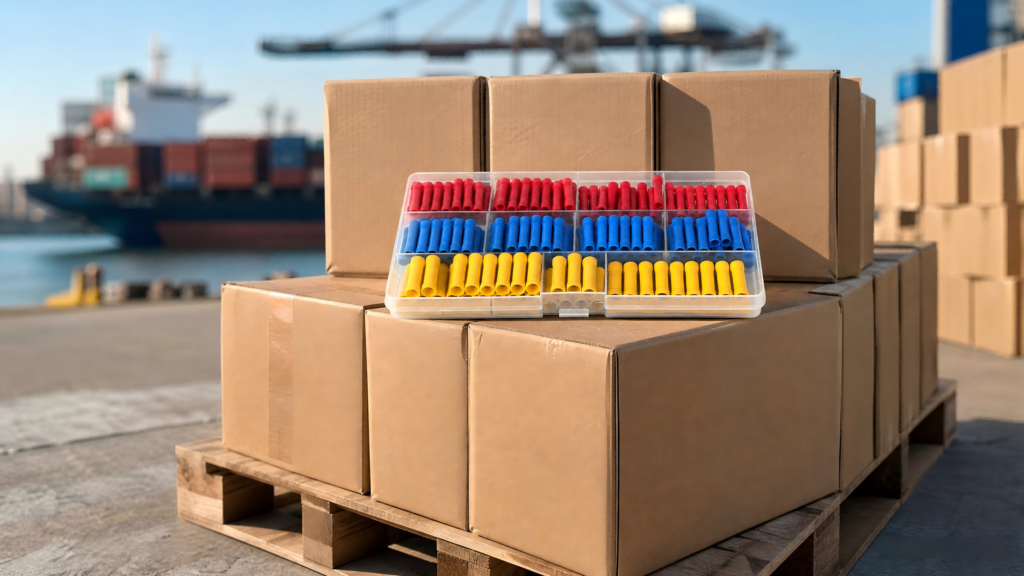
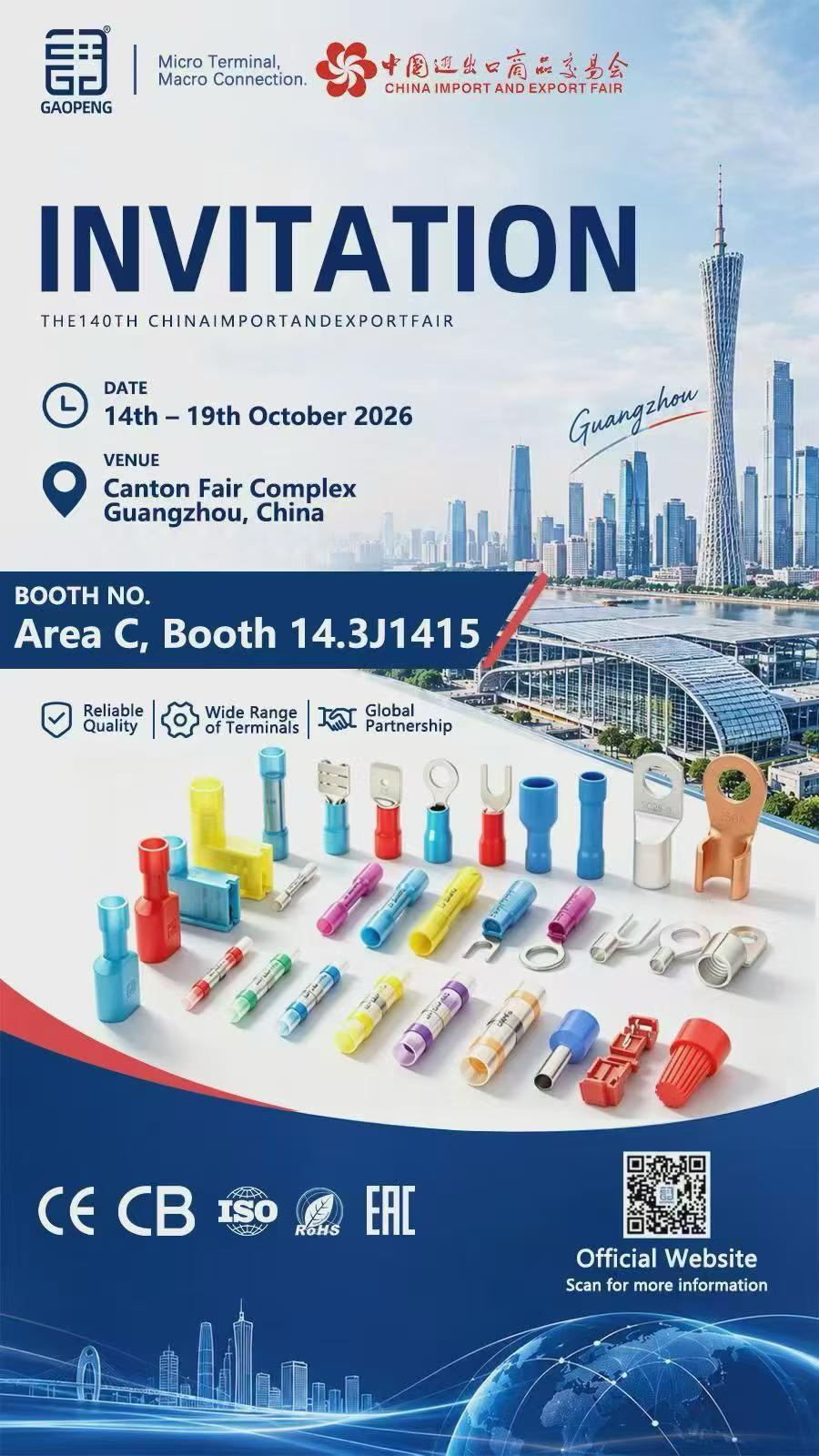
The row of colored terminals is the part of the booth that stops people, the quick splice in yellow, red and blue, the spade in pink and blue, the Butt Connector from white to orange, and the stop is always the same question, can we make this in our color. That one sentence starts the longest conversations of the fair, the OEM conversations, because the buyer who asks about color is the buyer who is building a product, and the product has a harness, and the harness has a color story, and the color story has to survive a factory. This article is the three conversations we had at the booth, custom color, custom marking, and the own mold, with what each one costs and the path from the booth table to the mass production line.
Custom color: what it costs and what it does not
The honest answer first, the standard colors cost nothing, because red, blue, yellow, black and white in shrink and PVC are the colors the line runs monthly and the mold is already open. The custom color is the one the product design needs, the brand color, the RAL number, the color that matches the housing the harness lives in, and the cost of it is not in the piece, it is in the setup, the resin batch, the color master, and the small first run that finds the match under the booth light and under the daylight, because the color that matches under one light is the color that lies under the next. What the buyer gets is a sample strip, the part in the matched color next to the swatch, signed off on the strip, never on the screen. The price on the custom color is the setup plus the piece, and the piece is the same price as the standard, so the setup is the price of the color itself.
Custom marking: printed, molded or laser
The marking is the second conversation, and it is the one that gets asked right after the color, the size stamp on the spade, the part number on the barrel, the polarity mark that keeps the harness from being assembled backwards. The marking is made three ways, printed, molded, and laser, and the three are read against the life of the part, the print is the cheap one and lives where nothing rubs, the molding is the mark that lives as long as the part, and the laser is the one that survives the abrasion and the solvent. The cost logic is the color logic, the marking is on the tooling or the station, fixed before the first article, paid in the setup. The mistake that comes back to us is the marking decided after the first order, because a mark added late is a tool changed late and a line stopped for the change. The booth answer is one line, the marking goes on the mold, so the marking is part of the drawing.
Own molds: when the standard part stops fitting
The third conversation and the longest, because the own mold is the moment the buyer stops buying a part and starts making a part. It comes when the standard size does not fit, the barrel is one millimeter too small for the wire, the spade is too long for the block, and the answer is the mold we make from the drawing on our own tooling line in Yueqing, which is the difference between a factory that molds its own terminals and a factory that orders them. The cost is the biggest of the three, the mold is a made part that pays for itself over the run, and the way we read it is the break even, the number of pieces at which the own mold is cheaper than the standard part with the compromise, and the number is written on the quote next to the price. What the buyer leaves the booth with is the drawing review, the mold quote, and the sample date, because the mold is the clock of the whole OEM conversation and the clock starts at the signed drawing.
From booth conversation to production order
The path is the same for all three conversations, and it is short enough to run in one season, which is why the fair is the best week to start it. The buyer sends the drawing or the part, the photo works for the first pass, and the color or the marking is named on the same email. We review it for manufacturability, the draft, the wall, the mark position, and the answer comes back as notes on the drawing, not as a no, because the note is the manufacturer talking. The sample runs, the strip for the color, the first article for the mark, the mold trial for the own part, and the sign off is on the sample in the hand. Then the production order, the carton, the packing, and the file, the certificate and the test report named by the part. What keeps the path from ending in a folder is the writing, every date in an email, every decision on a drawing, because the conversation that lives in memory dies between seasons, and the one that lives in the file ships.
|
Customization |
What it costs |
What we need first |
|
Custom color |
setup, resin batch, first run |
RAL or swatch, the part number |
|
Custom marking |
setup on tooling or station |
mark text, position, method |
|
Own mold |
mold, paid over the run |
the drawing, the wire, the volume |
|
Sample |
stock sample or first article |
photo for stock, drawing for made |
|
File |
included with the order |
which marks your market reads |
- Send the drawing or the part photo with the color and marking named.
- We answer with DFM notes on the drawing, not a yes or a no.
- The sample runs, color strip, first article, or mold trial.
- Sign off on the sample in the hand, not on the screen.
- Production follows, with the certificate file named by the part.
We are Yueqing Gaopeng Electric, a terminal manufacturer in Yueqing since 2016, and the own mold is the reason the color on our table is not a promise, it is a part we made and a tool we own. The OEM conversation at 14.3J1415 is the color, the mark and the mold, in that order, and it ends the same way every time. Send us the drawing and the color, and we will come back with the sample date in writing and the sample on its way.