







What is the difference between a terminal block and a terminal?
A terminal is a general concept that refers to a 'single component' used to achieve an electrical connection.
A Terminal Block, on the other hand, is a specific and common form of terminal. It is a modular component made by assembling multiple 'terminals' onto a fixed structure (rail or strip).
We can use an analogy to understand this:
A terminal is like a 'single LEGO brick.' It can come in many shapes and functions (screw-type, plug-in type, spring type, etc.).
A terminal block is like 'assembling multiple LEGO bricks together to form an entire row structure.' It facilitates centralized management and installation.
Terminal blocks are a general term referring to all components used for reliable wire connections.
Definition: An auxiliary device used to achieve electrical connections. It usually consists of both an insulator and a metal conductor and is designed to conveniently and reliably connect single or multiple wires together.
Features:
- Can be a standalone individual component.
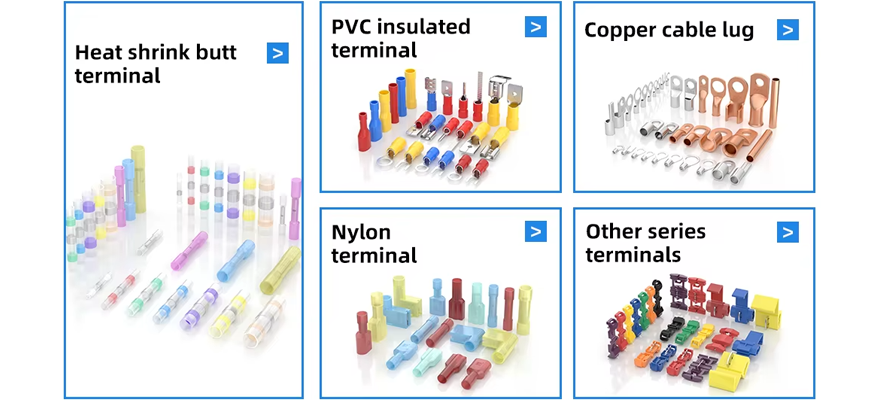
- Extremely diverse types, classified by connection method such as screw type, spring type, solder type, plug-in type, barrier type, through type, etc.
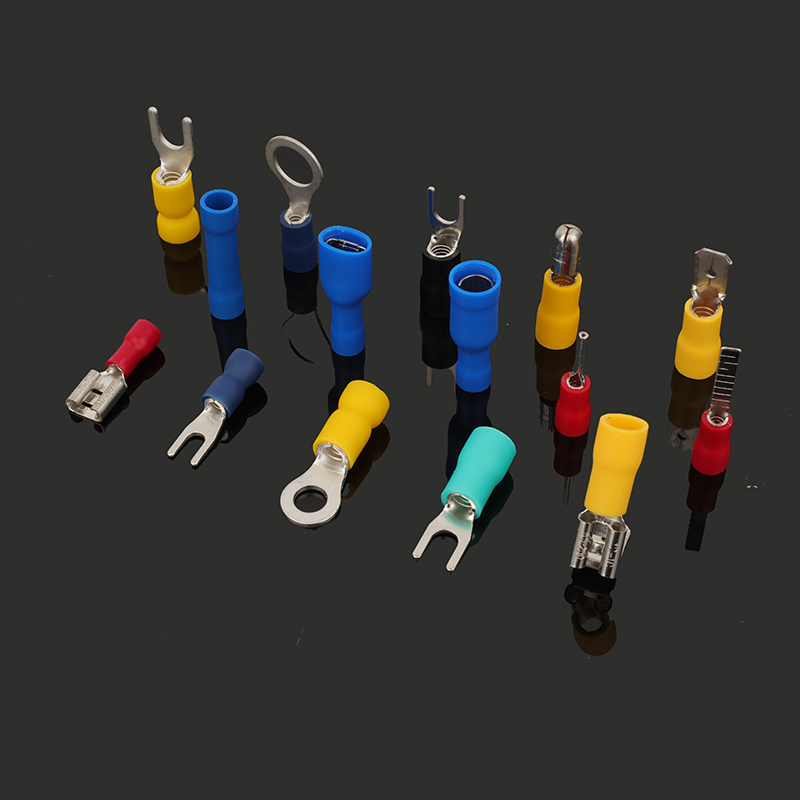
- Various shapes and functions; for example, Wire ferrules, OT/UT connectors, PCB terminal blocks, plug-in connectors, etc., all fall under the broad term "terminal blocks."
Application: Anywhere wire connection or termination is needed.
Terminal block strips are the most common and standardized subset within the "terminal block" category.
Definition: A multi-circuit connection module formed by arranging multiple structurally identical "terminal block units" at a certain spacing and fixing them on a common insulating base (usually a rail or strip).
Features:
- Modular: The number of positions can be flexibly increased or decreased (e.g., 4 positions, 12 positions, 24 positions, etc.).
- Standardized: Unified widths (e.g., modular widths, common widths like 5mm, 5.08mm, 10mm, etc.) for easy installation on standard rails.
- Centralized: Facilitates the centralized management, labeling, and maintenance of a large number of wires.
- Usually equipped with a marking system (label strip) to easily number each circuit.
Application: Suitable for distribution boxes, control cabinets, PLC modules, instrument panels, and other situations requiring a large number of orderly connected industrial electrical devices.