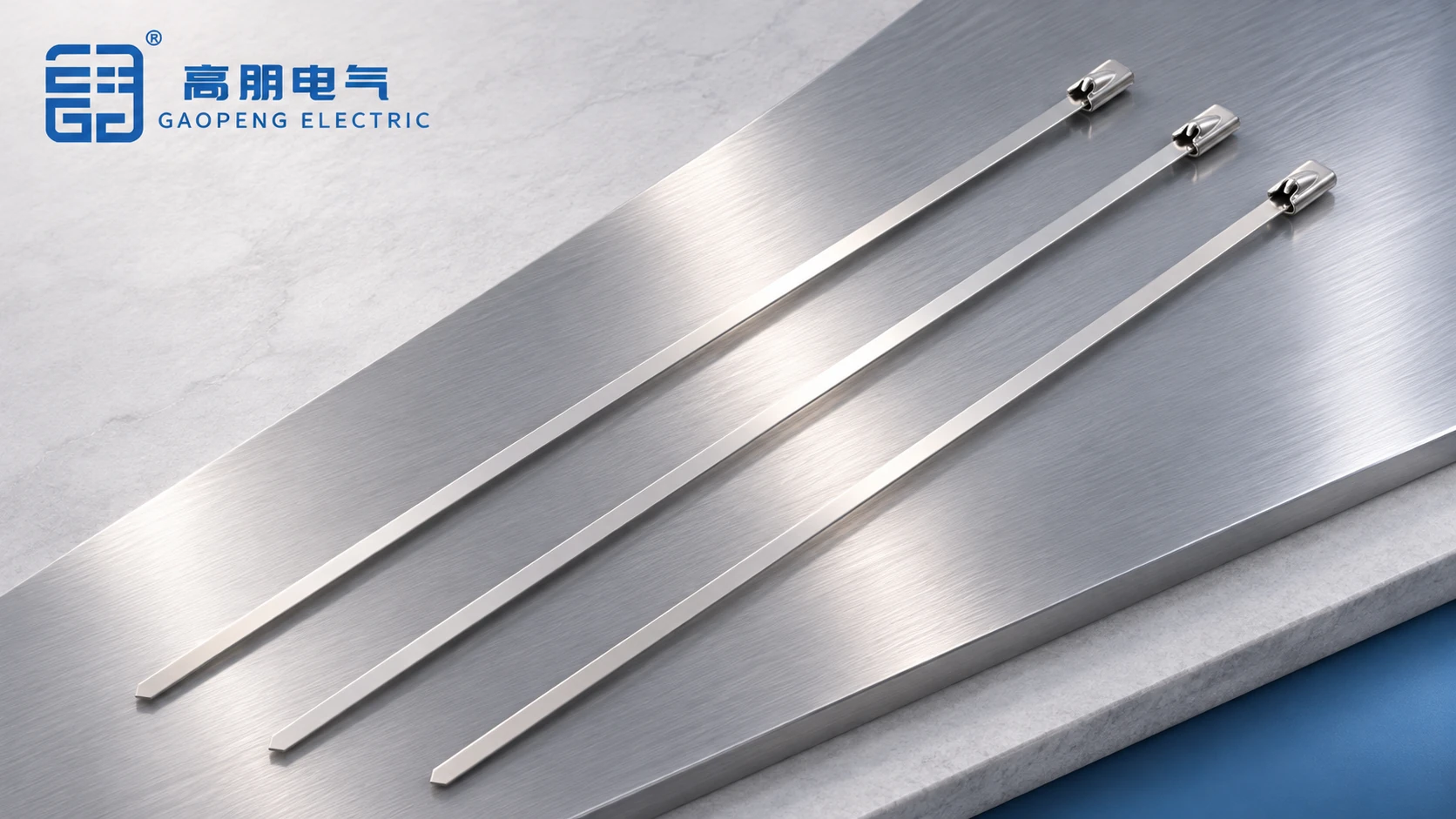
When comparing 304 vs 316 stainless steel, the main difference is the molybdenum alloying in 316, which improves resistance to localized corrosion in chloride-containing environments. For cable ties, that makes 316 worth considering when salt exposure is a concern. It does not establish the load capacity, locking performance or service life of a finished tie.
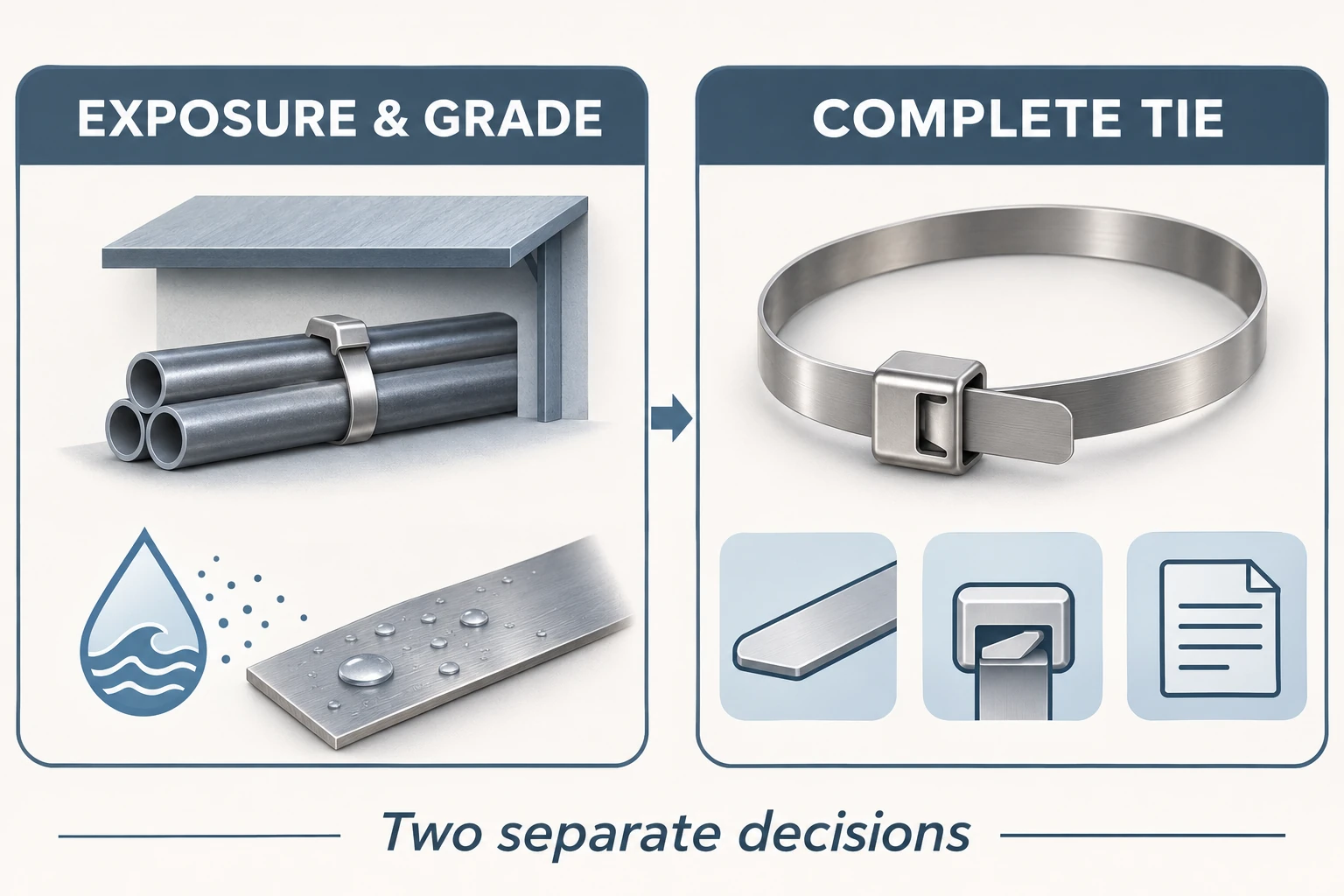
Choose the material against the actual environment, then confirm the complete tie specification. A sheltered indoor bundle and an exposed coastal installation should not share a material decision simply because both use stainless steel straps.
304 vs 316 stainless steel: what changes?
Both grades belong to the austenitic stainless steel family. Outokumpu describes 304 as a general-purpose chromium-nickel grade. The important distinction for this comparison is that 316 contains molybdenum, giving it better resistance to chloride-related pitting and crevice corrosion. Pitting is localized attack at small areas; crevice corrosion develops in restricted spaces where local conditions become unfavorable.
| Selection point | 304 | 316 |
|---|---|---|
| Material family | Austenitic chromium-nickel stainless steel | Austenitic chromium-nickel-molybdenum stainless steel |
| Reason to consider it | A starting candidate where the exposure assessment supports its corrosion resistance | A candidate where improved chloride-related corrosion resistance is needed |
| What the grade cannot establish | Finished-tie capacity, lock retention or suitability for every environment | The same limits apply; “316” is not a complete tie specification |
Outokumpu places its molybdenum-alloyed grades in the Supra range for applications requiring increased corrosion resistance. That supports the material distinction here; it does not turn a steel producer’s grade description into a performance statement for a finished cable tie.
Match the grade decision to the exposure
Describe what reaches the tie surface before selecting a grade. “Outdoor” is too broad: a sheltered installation with little salt exposure differs from one that retains chloride-bearing deposits or stays wet.
| Exposure described by the buyer | Useful starting decision | Information still needed |
|---|---|---|
| Dry or sheltered service without identified aggressive exposure | Evaluate 304 against the project specification | Actual contaminants, cleaning conditions and acceptance criteria |
| Chloride-bearing deposits or coastal salt exposure | Evaluate whether 316 provides the required corrosion resistance | Wetness, deposits, temperature and access for cleaning or inspection |
| Persistent immersion, aggressive chemicals or severe chloride exposure | Obtain a materials assessment rather than choosing between the two by label alone | Full exposure conditions and a documented material recommendation |
This matrix is a way to organize a selection discussion, not a material approval. ASSDA identifies 316 as a step up from 304 but also describes severe environments where other alloys may be needed. Calling 316 “marine grade” therefore does not establish suitability for every marine location.
Verify the finished tie separately from the material
A material decision leaves several product decisions open. The strap must suit the bundle, the locking arrangement must match the intended installation, and the selected part must have the evidence required by the project. Material-property data for sheet or strip cannot serve as a finished cable-tie load rating.
Gaopeng’s listing identifies self-locking stainless steel cable ties in 304 and 316 options. It asks buyers to specify bundle diameter, strap width and length, environmental exposure, and installation or trimming requirements. These are useful inputs for selecting an order reference; the listing does not provide a verified load or temperature rating for every variant.
Keep geometry and acceptance criteria separate in the enquiry. For geometry, identify the strap dimensions and bundle requirements. For acceptance, state any required finished-product load evidence, locking checks, material documentation and application-specific approvals. Ask the supplier to confirm what is available for the exact reference before treating those requirements as satisfied.
A change from 304 to 316 should therefore remain a controlled part change. Record whether the requested strap size and locking design stay the same, and ask which supporting documents apply to the replacement reference.
Compare quotations on the same cable-tie specification
For a useful price comparison, start with the Gaopeng 304/316 self-locking cable-tie range and request equivalent versions. A quotation for a different strap size, quantity or documentation package will not isolate the cost of the grade choice.
Consider this hypothetical enquiry for an exposed coastal bundle. The dimensions below are buyer-proposed inputs, not confirmed Gaopeng stock sizes or an approved design.
| Enquiry input | Option A | Option B |
|---|---|---|
| Material requested | 304 stainless steel | 316 stainless steel |
| Bundle and proposed strap | 30 mm bundle; 4.6 mm wide × 200 mm long strap | Same proposed geometry |
| Locking arrangement | Self-locking; exact reference to confirm | Same arrangement; exact reference to confirm |
| Quantity and destination | 1,000 pieces; Houston, US | 1,000 pieces; Houston, US |
| Exposure and documents | Coastal salt deposits; request material identification and applicable finished-tie evidence | Same exposure and document request |
That example is an ordering framework, not a recommendation to approve both grades. If the project already specifies 316, an alternative 304 quotation still needs approval from the responsible project team. If the exposure is not yet defined, a lower initial price does not resolve the material question.
The comparison is ready for a purchasing decision when the material choice has a documented reason and the complete tie requirements have been confirmed. Neither the grade name nor a generic corrosion comparison can replace that final product check.
References
Outokumpu — Core stainless steel grades
ASSDA — 316: The First Step Up
Outokumpu — Supra stainless steel grades