The best wire stripping tool is the one whose documented wire range and controls fit the conductor, insulation and required strip length. A manual stripper is worth comparing for a known, consistent wire size; a self-adjusting model is worth comparing when the job involves different sizes. Neither mechanism guarantees a suitable result on every wire.
This guide compares manufacturer specifications for named tools and Gaopeng’s published product listing. It is a document-based selection guide, not a hands-on test, speed comparison or “best overall” award. The intended task is terminal preparation on disconnected wire.
Choose the best wire stripping tool against the job
Start with the actual wire reference and the terminal’s preparation requirements. The tool needs to accommodate the conductor construction and insulation being processed, while the finished stripped length must match the connection requirement. A broad capacity range is useful only if it includes the actual wire and the tool produces an acceptable prepared end.
Keep three questions separate: what the tool can strip, which controls it provides, and what the selected terminal requires. Extra cutting or crimping functions do not answer all three questions.
Compare published model ranges and controls
The table keeps solid and stranded ranges separate where the manufacturer does. It reproduces stripping capacities only; it does not treat a cutting capacity as a stripping range or transfer one model’s controls to another.
| Tool | Published stripping range | Mechanism or relevant controls | Selection question |
|---|---|---|---|
| Klein Tools 11055 | 10–18 AWG solid copper; 12–20 AWG stranded copper | Manual wire stripper/cutter | Does the appropriate conductor-specific range cover the wire? |
| Klein Tools 11061 | 10–20 AWG solid; 12–22 AWG stranded | Self-adjusting head, adjustable stopper and tension adjustment | Do its controls suit the insulation and required prepared length? |
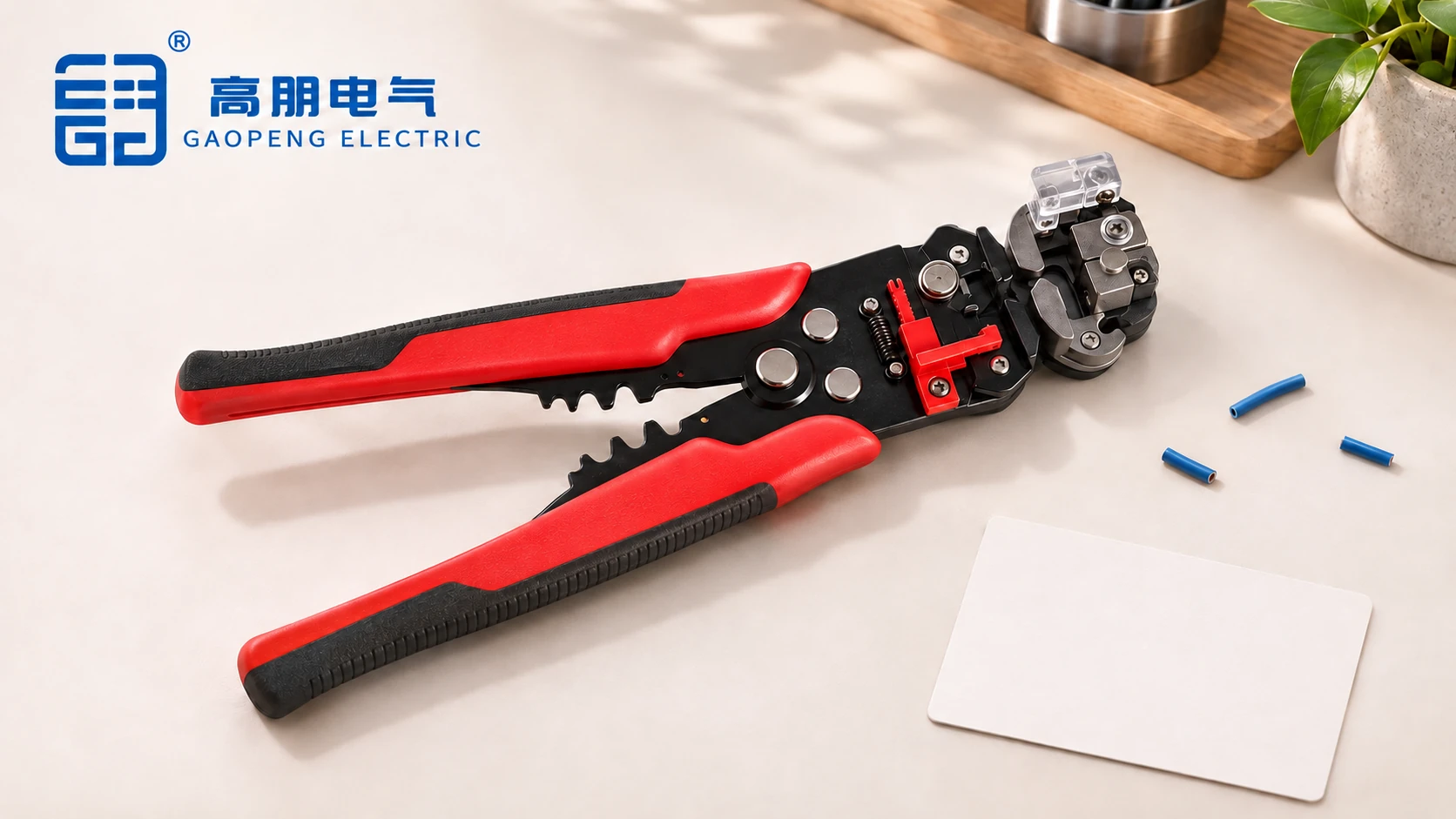
| Gaopeng GP-BX series | 0.2–6 mm² / AWG 10–24, as listed | Self-adjusting mechanism; interchangeable SK5 blades | Which GP-BX variant and instructions apply to the actual wire? |
The two Klein rows come from the respective manufacturer datasheets. The GP-BX row comes from Gaopeng’s current listing, which identifies GP-BX-01, GP-BX-02 and GP-BX-03. Its combined range does not separately establish every solid, stranded or insulation combination. Confirm the selected variant rather than extending another manufacturer’s acceptance to it.
Match the mechanism to the preparation task
For one familiar wire reference, a manual model can be a practical candidate if its documented range matches that construction. For a changing mix of wire sizes, a self-adjusting head becomes a relevant comparison point. The choice still needs a sample check with the actual insulation.
| Job requirement | Feature to compare | What to confirm |
|---|---|---|
| One repeated wire reference | Correct conductor-specific capacity and handling | The prepared end meets the terminal requirement |
| Several sizes within a documented range | Self-adjusting head and available adjustment controls | Each wire reference strips acceptably |
| Repeated preparation length | An appropriate length stop, where documented | The set length matches the terminal instruction |
| Insulation that is not clearly covered | Manufacturer material guidance and a representative sample | Suitability before a production order |
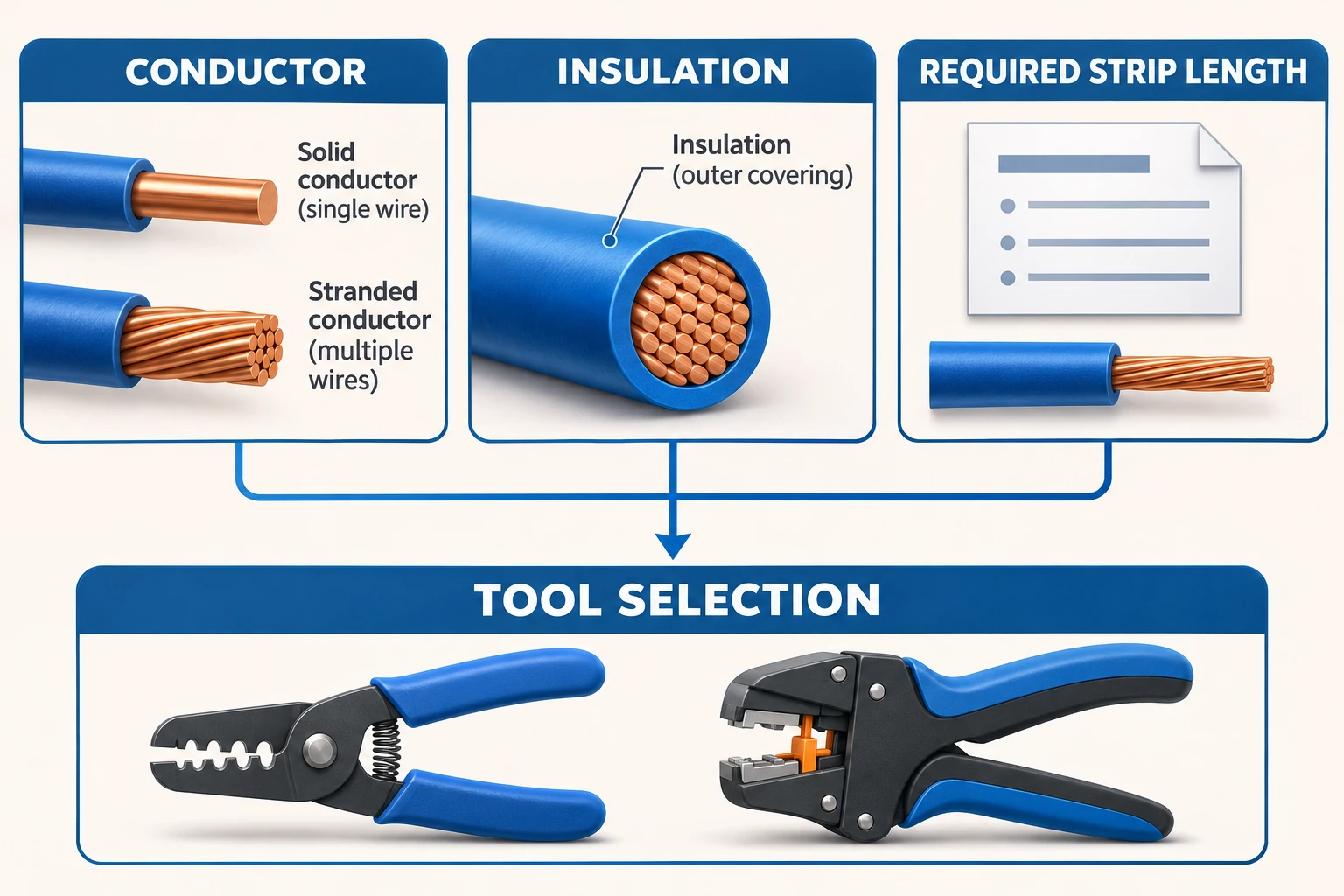
An adjustable stop is a control to compare, not a reason to choose an arbitrary strip length. The connector or terminal instruction supplies the requirement; the tool setting must follow it.
Use a sample check before committing the order
Agree what an acceptable prepared wire looks like before comparing samples. Record the wire part number, conductor construction, insulation, tool model and applicable settings alongside the terminal reference. This gives the evaluation a reproducible starting point without claiming a production trial has already occurred.
Check the prepared length against the terminal instruction. Inspect the conductor for visible nicks, missing strands or distortion, and look for insulation remnants that interfere with preparation. Record any defect and resolve the tool setting, wire suitability or preparation method before proceeding.
A clean-looking stripped end is only the preparation result. It does not establish the electrical or mechanical quality of a later crimp. Keep the terminal and crimp-tool acceptance checks separate from the stripping-tool decision.
For a mixed-wire job, retain a result for each wire reference rather than approving the whole range from one sample. A useful comparison records which combinations were checked and the limits of that evaluation.
Select the GP-BX version with the wire details
Gaopeng’s GP-BX automatic wire stripper listing provides a starting range and series identity. Send the wire reference, construction, insulation information, required strip length and intended production or maintenance use when asking which version to supply.
The listing includes strip, cut and crimp functions, but its stripping range is not a universal crimping range. If crimping is part of the purchase, identify the terminal and required die profile separately and obtain the applicable instructions for that combination.
Choose from the documented fit to the job and the agreed sample result. A longer feature list alone cannot resolve an unknown wire, an unspecified terminal or an unconfirmed variant.
References
Klein Tools — 11055 manufacturer datasheet
Klein Tools — 11061 manufacturer datasheet