A cable gland size chart must match two different interfaces: the cable jacket and the enclosure entry. Compare the actual cable outside diameter with the selected gland’s clamping range, then check the complete entry-thread designation and mounting requirements. A thread label such as M20 does not identify a universal cable-diameter range.
Keep the product reference with every chart row. Different gland designs can use the same entry thread while specifying different cable ranges, thread lengths and accessory requirements.
A model-scoped metric cable gland size chart
The following examples come from the external ST-M silver-grey catalog cited in the references. They show how thread, clamping range and thread length are recorded separately. These values are not Gaopeng specifications or universal limits for every gland with the same metric thread.
| External article reference | Entry thread | Cable clamping range (mm) | Thread length (mm) |
|---|---|---|---|
| 53111000 | M12 × 1.5 | 3.5–7 | 8 |
| 53111010 | M16 × 1.5 | 4–10 | 8 |
| 53111020 | M20 × 1.5 | 6–13 | 9 |
| 53111030 | M25 × 1.5 | 8–17 | 10 |
| 53111040 | M32 × 1.5 | 9–21 | 10 |
Use a chart like this to identify candidate references, then check the selected product’s drawing and installation requirements. Do not copy its cable range into another supplier’s quotation merely because the thread designation looks the same.
The same M20 thread can describe different selections
The same catalog lists reference 53111020 with an M20 × 1.5 entry, a 6–13 mm cable range and a 9 mm thread length. Its long-thread reference 53017030 also uses an M20 × 1.5 designation, but lists a 5–12 mm cable range and a 13 mm thread length.
That contrast demonstrates why “M20 cable gland” is incomplete as an order description. It leaves the cable fit and mounting length unresolved. The two examples are not an instruction to substitute one for the other.
For a comparison record, retain the complete article reference, thread designation, cable range and thread length in separate columns. This makes the reason for selecting a particular variant visible when procurement receives an alternative quotation.
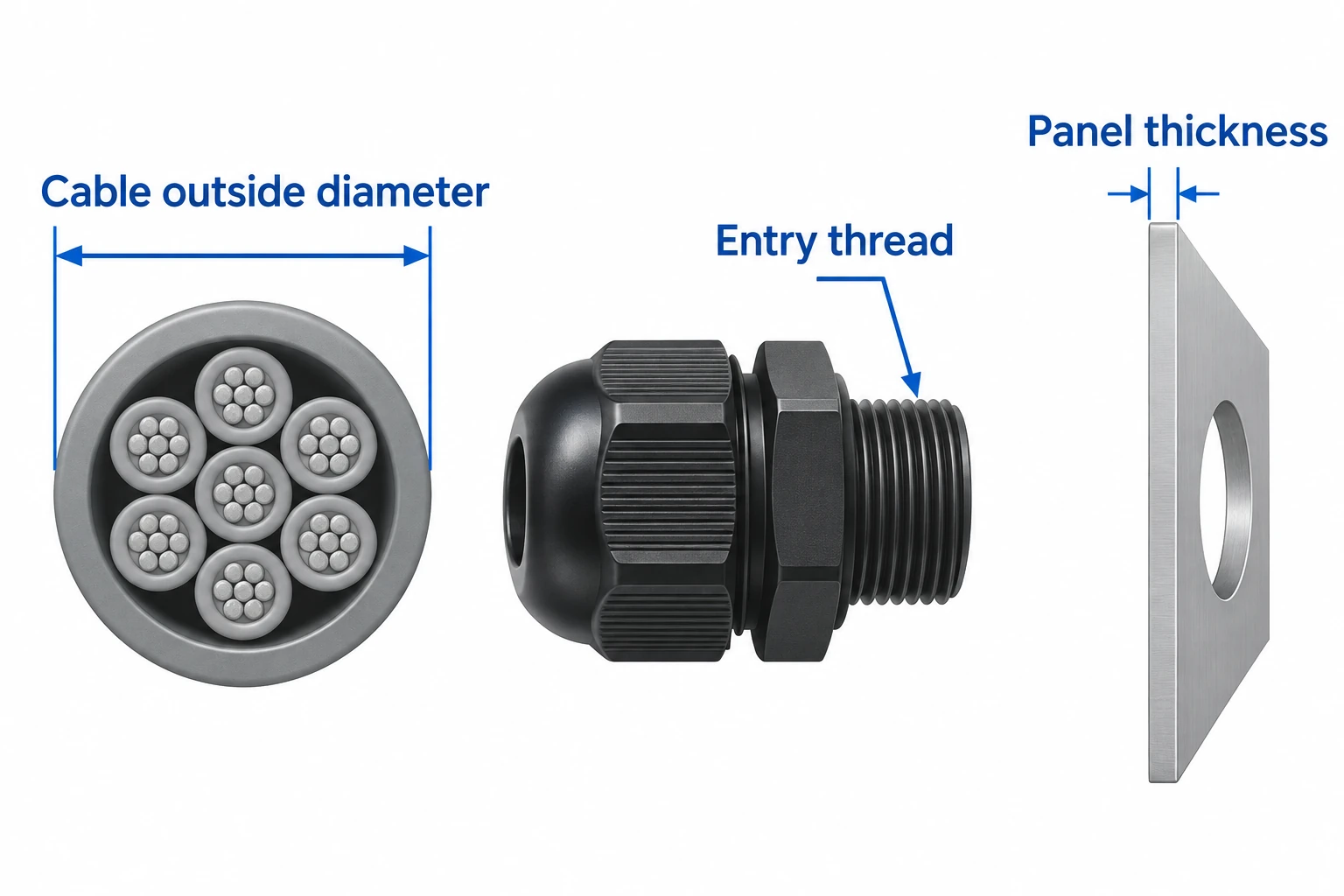
Measure the cable jacket that the gland will engage
Specify the actual outside diameter of the cable at the intended gland location, together with the cable construction and jacket information needed for selection. Conductor cross-section and core count do not independently define that outside diameter.
Compare the cable information with the selected gland’s documented clamping and sealing requirements. Where the cable specification gives a dimensional range or the jacket shape creates uncertainty, include that information rather than sending a single assumed diameter.
A dimensional match is one selection check. It does not, by itself, establish the required retention, environmental or sealing performance. Keep those requirements explicit so the supplier can review the proposed cable and gland combination.
Check the entry, panel and accessories as an assembly
Identify the enclosure entry type and complete thread designation, including pitch where applicable. Confirm the selected gland against the enclosure drawing rather than treating metric, PG or NPT labels as interchangeable size names.
Panel thickness and the required mounting arrangement affect the thread-length check. Include any locknut, washer or other specified accessory in that review. The relevant question is whether the complete mounting arrangement meets its documented requirements, rather than whether the gland’s thread can enter the opening.
State the ingress-protection and environmental requirements of the equipment separately. Request the applicable sealing arrangement and assembly documentation for the selected entry. A component designation is not independent evidence of the finished enclosure’s performance.
Prepare a defined Gaopeng nylon-gland specification
Gaopeng’s nylon cable glands are published for cable entry and retention with an IP68 designation. The product page asks buyers to match the thread, cable clamping range and enclosure entry, and to request documentation for the selected combination.
Provide the enclosure-entry drawing, panel thickness and actual cable outside diameter with the cable’s construction details. State the required sealing arrangement, environmental exposure and ingress-protection requirement. Ask for the proposed gland reference, its dimensional record and the documents applicable to that assembled cable entry.
Keep the quantity and requested accessories separate for each confirmed variant, and include the delivery destination. This gives purchasing a specific item to compare while preserving the cable, thread and panel conditions that engineering needs to check.