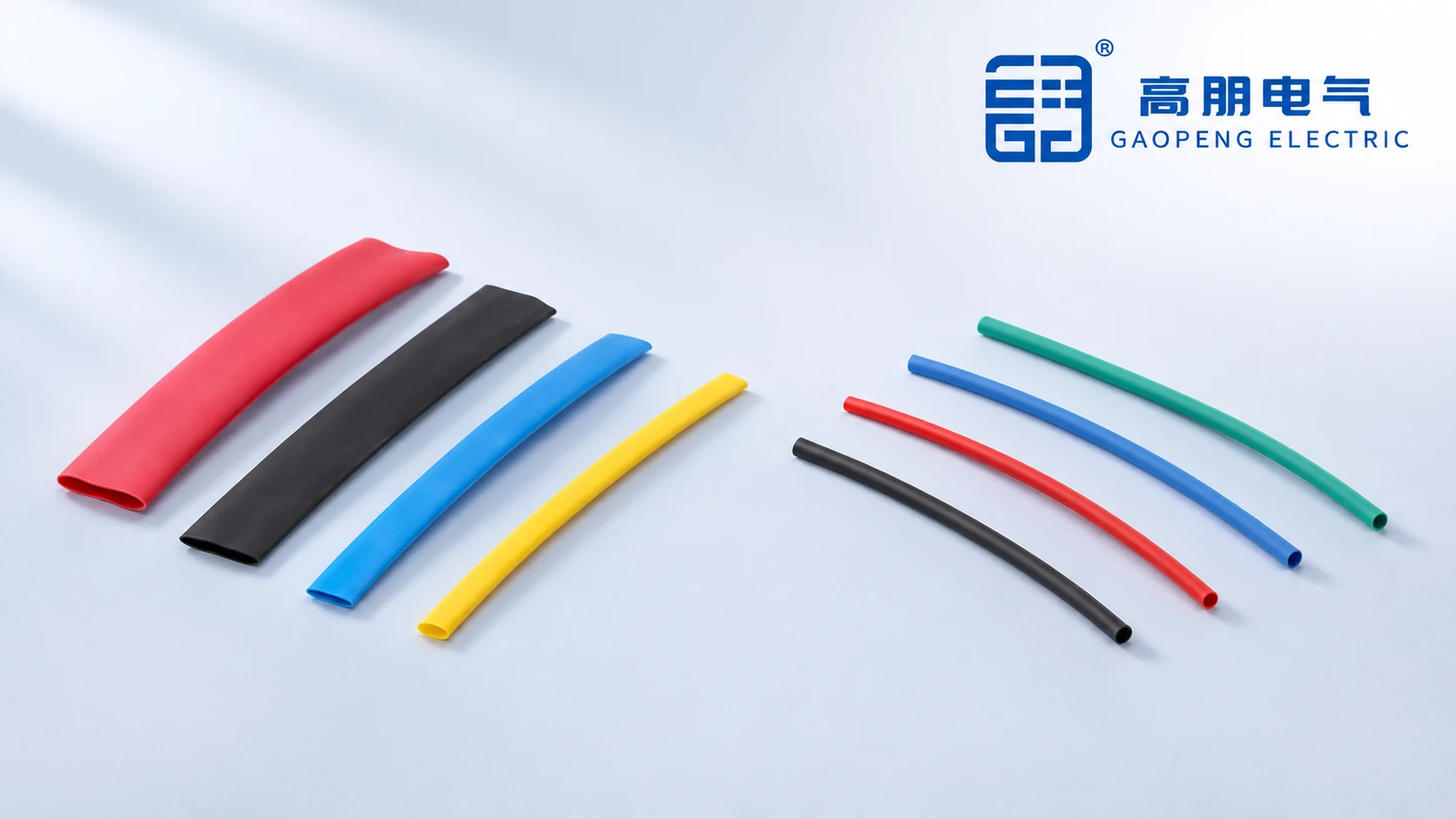
Select heat shrink tubing sizes by checking both the supplied opening and the required recovered fit. The expanded internal diameter must clear the largest feature the tube passes over. The documented recovery dimensions must also suit the smaller surface it will cover after shrinking. A shrink ratio alone does not answer both questions.
Record the largest installation obstruction, the final cable or joint outside diameter and the required covered length before comparing tubing references. Those measurements describe the application more usefully than a wire gauge alone.
Read heat shrink tubing sizes as two dimensional limits
Expanded ID is the internal diameter in the supplied state. Where the specification gives a minimum expanded ID, use that minimum for the entry-clearance check. Do not assume the delivered tube will always have a larger opening than the published minimum.
Recovered ID describes the tube after recovery under the specified conditions. A maximum recovered ID is an upper bound, rather than a promise that every specimen reaches that exact dimension. Keep the manufacturer’s recommended installation window with these values when evaluating the final fit.
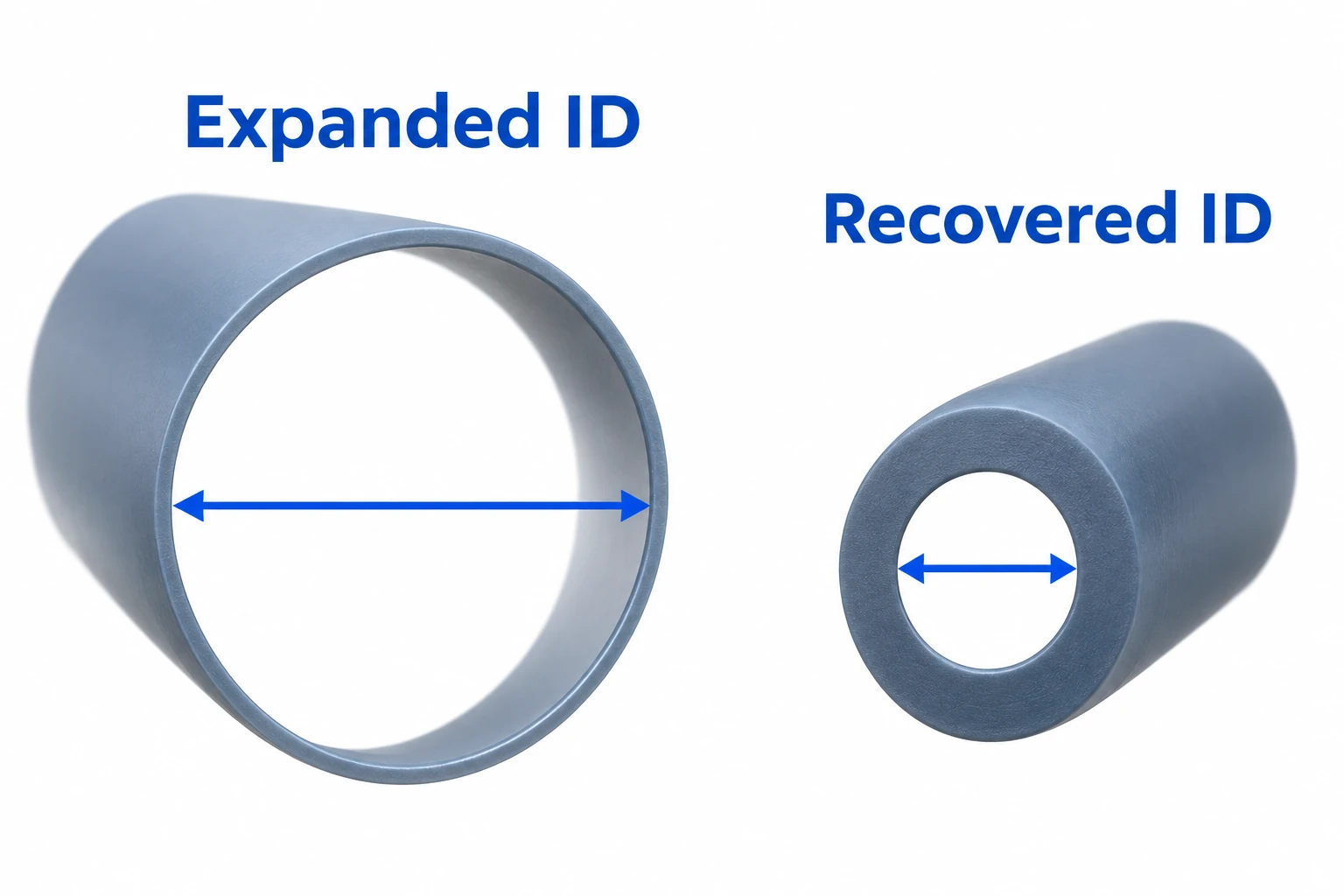
The entry feature and final substrate may be different sizes. A connector can be the largest obstruction, while the cable jacket behind it determines the final fit. Measure both parts of that path instead of selecting from the smaller cable diameter alone.
A hypothetical size screen: two tubes with the same opening
Consider a round assembly with a largest obstruction of 5 mm and a final cable outside diameter of 2.5 mm. The following candidates are hypothetical dimensional limits used to explain the comparison. They are not Gaopeng product specifications or an approved repair selection.
| Candidate | Minimum expanded ID | Maximum recovered ID | Preliminary geometric result |
|---|---|---|---|
| A | 6 mm | 3 mm | Clears the 5 mm obstruction; documented recovery does not establish a fit below 2.5 mm |
| B | 6 mm | 2 mm | Clears the obstruction and documents a recovery maximum below 2.5 mm |
Candidate A’s 3 mm maximum does not mean every tube stops at exactly 3 mm. It means those published limits alone are insufficient to establish the required recovery around a 2.5 mm substrate. Guessing that an individual specimen might shrink further is not a specification.
Candidate B passes these two preliminary geometric checks. It still needs review against its manufacturer’s installation window, wall construction and application requirements. The table screens dimensions; it does not establish installed insulation, sealing performance or suitability for the equipment.
Use shrink ratio to narrow the search
Shrink ratio relates the supplied and recovered diameters. In the simplified hypothetical example, 6 mm to 3 mm corresponds to 2:1, while 6 mm to 2 mm corresponds to 3:1. A higher ratio can provide a wider dimensional change, but the actual specified ID limits remain necessary.
Two products carrying the same nominal ratio can have different supplied sizes, recovered limits and wall constructions. Keep the complete reference and dimensional row when comparing them. “3:1 tubing” is an incomplete order description.
Wire gauge is also an incomplete sizing input. It does not describe the largest connector or joint that the tube must pass over, nor the complete outside envelope of an insulated assembly. Use the relevant outside dimensions and the product’s documented fit requirements.
Wall construction and cut length remain separate choices
Choose the required wall and adhesive construction alongside the diameter. Single-wall and adhesive-lined tubing are different constructions. An adhesive lining should not be treated as an automatic approval for every sealing application; the selected version and installation conditions need their own documentation.
Length can change during recovery as well. Obtain the selected tubing’s longitudinal-change specification before deciding the cut length needed for the final covered area. A diameter ratio is not a longitudinal-shrinkage allowance.
Keep installation-process and environmental requirements in the same enquiry. The correct diameter does not independently establish the required operating temperature, electrical insulation properties or sealing capability.
Turn the measurements into a Gaopeng tubing enquiry
For Gaopeng’s heat shrink tubing range, provide the cable or joint outside diameter, the largest feature on the installation path and the required recovered fit. State the wall and adhesive construction, required covered length and application environment.
Request the proposed reference’s minimum expanded ID, maximum recovered ID, recommended fit window and longitudinal-change information. Include the installation-process requirements so the supplied version can be reviewed as a complete specification.
List cut lengths and quantities separately for each confirmed version, together with the delivery destination. This gives the quotation a defined dimensional basis and leaves the application-specific performance requirements visible for confirmation.