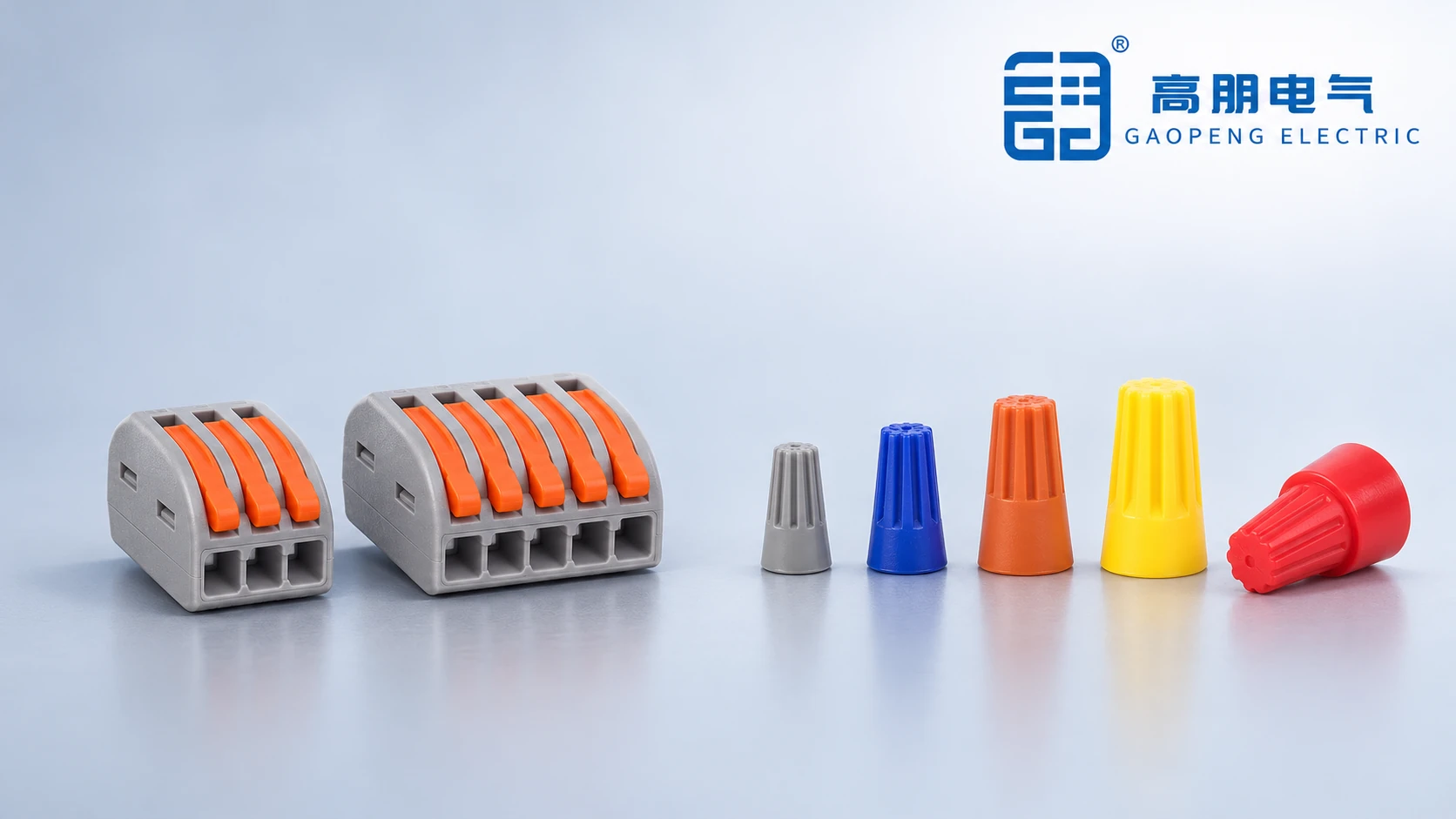
A lever nuts vs wire nuts comparison depends on the exact conductors, connection arrangement and documented rework requirements. Both formats can be candidates for a wire-joining task. A lever operates a releasable connection; a twist-on cap uses a different actuation method. Neither family name proves that a particular part fits the assembly.
“Lever nuts” is common search language; WAGO uses Lever-Nuts® for its products. The Gaopeng products discussed here are Gaopeng lever wire connectors and SP twist-on caps. Their specifications need separate confirmation rather than an assumed cross-brand equivalence.
Lever nuts vs wire nuts: compare the selection record
| Buying question | Lever-operated candidate | Twist-on candidate |
|---|---|---|
| Conductor compatibility | Identify the permitted conductor at each entry | Confirm the complete combination inside one cap |
| Connection arrangement | Confirm entry count, physical layout and electrical connections | Identify the wires joined in the same cap |
| Service requirement | Check the selected part’s release and rework instructions | Check removal, replacement and reuse conditions in its instructions |
| Physical fit | Check the body envelope and required lever access | Check the cap envelope and assembly access |
Record each conductor before comparing the connectors
A lever connector comparison begins with the size and construction of every incoming conductor. Manufacturers offer different variants within one family, so a family-wide headline is insufficient. Buyers need the exact part’s accepted conductor information and the required entry arrangement.
For a twist-on connector, the complete bundle matters. A published minimum and maximum combination does not establish every possible mixture between those endpoints. The buyer needs a documented combination matching the conductor count, size and construction. Cap color alone cannot provide that match.
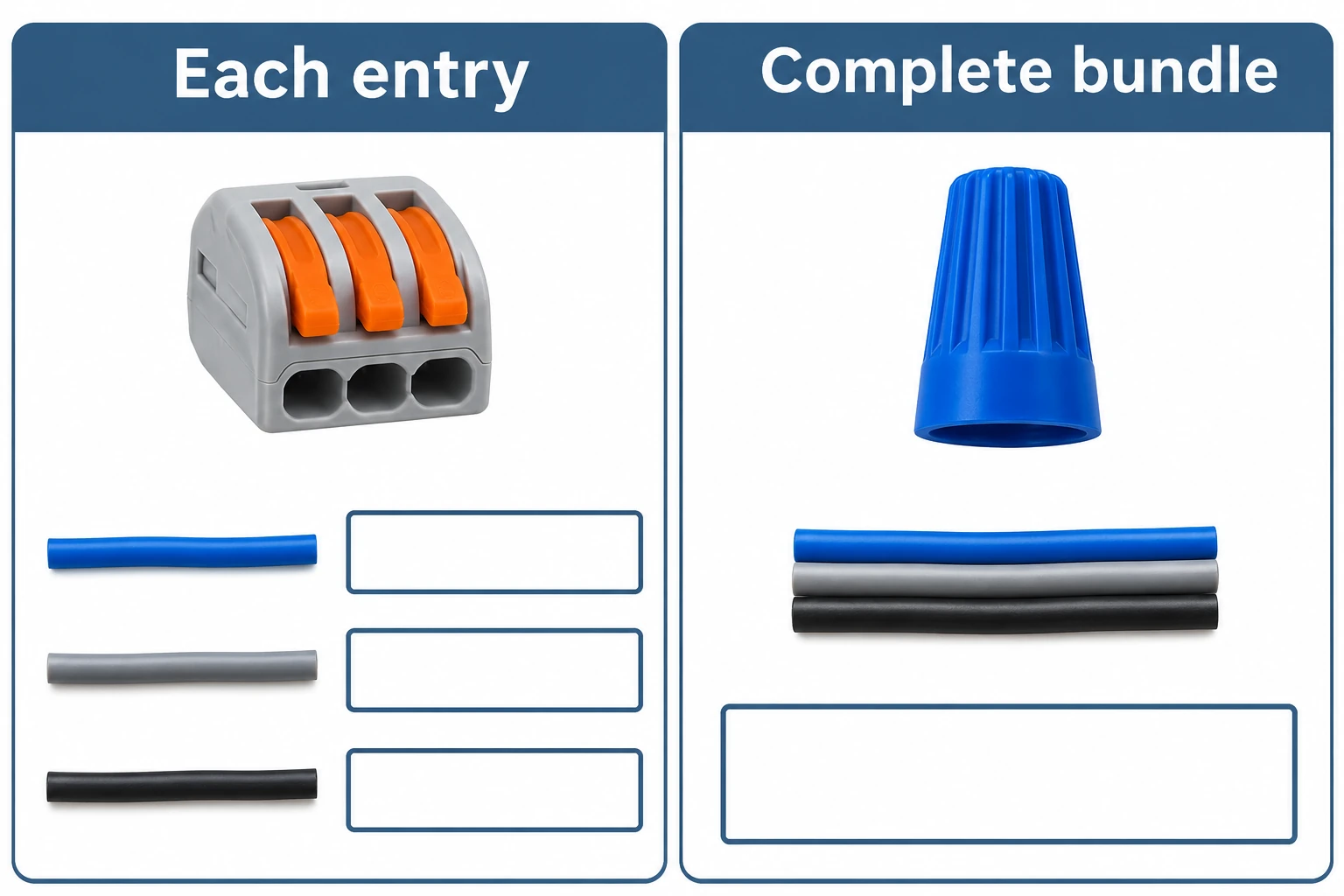
These records make the comparison specific without choosing a winner in advance. A candidate remains unresolved if the supplier has not confirmed the actual conductors. A familiar body shape or a similar wire-range headline does not close that gap.
The same record should distinguish electrical arrangement from visible entry count. Buyers should obtain the selected connector’s diagram rather than assume how an unfamiliar product joins its positions.
A single-wire change is a useful rework test
Consider an assembly in which one conductor may change during servicing. For a lever-operated candidate, the buying question is whether the selected part’s documentation permits the intended release and reconnection. The team also needs access to operate the relevant lever in the actual enclosure.
For a twist-on candidate, changing one conductor changes the bundle requiring confirmation. The service plan must cover the resulting combination, conductor preparation and the manufacturer’s conditions for the connector itself. A generic statement that “wire nuts are reusable” does not establish what that part’s instructions permit.
This scenario helps buyers compare documentation and access requirements. It does not establish that one method is always faster, safer or less expensive. Those conclusions would require evidence for the actual assembly and work process. Releasability also differs from pluggability: releasing a wire does not prove that the connector provides a separate plug-and-socket interface.
Check space and exposure against the exact variant
The connection must fit the planned enclosure with the required assembly and service access. A comparison of loose product widths can miss the space needed around the installed conductors. The drawing and proposed arrangement should therefore travel together during selection.
Environmental requirements need the same discipline. A transparent housing does not establish a moisture rating, and a plastic cap does not establish suitability for every location. Buyers should ask which variant and supporting documentation address the stated conditions. This comparison does not supply installation approval or substitute one manufacturer’s ratings for another’s.
Apply the actual Gaopeng product information
Gaopeng’s lever wire connector page identifies lever operation and a releasable wire connection. It asks buyers to specify connection count, physical arrangement and whether pluggability is required. Conductor construction and cross-section, load, voltage, installation space and environment are also selection inputs. These are questions for confirming a variant, not evidence that every version meets every requirement.
The SP twist-on wire connector page lists several references and cap dimensions. It directs selection by the complete conductor combination. The conductor strings in its table do not explicitly label their unit, so a buyer should request clarification rather than reinterpret them as an established wire range.
For either format, request the exact reference, drawing and applicable preparation and inspection instructions. An external manufacturer’s wire limits or installation method cannot fill a missing Gaopeng specification.
Choose a documented part for the assembly
A useful comparison ends with a specific part reference and the reason it meets the requirement. The record should show the conductors, connection arrangement, physical fit, environment and required rework method. Any unresolved field remains a supplier-confirmation question.
That record also makes alternatives easier to assess. The buyer can keep the assembly requirements fixed while comparing candidate documents. The decision then rests on confirmed fit and service needs, rather than on a blanket preference for a lever or a cap.