
Select ring terminal sizes by matching the conductor range and the stud interface independently. The wire barrel must suit the conductor and its specified crimp process. The ring hole must suit the mounting hardware, while the surrounding tongue must fit the available contact space. Sleeve color alone does not resolve those requirements.
A useful terminal specification therefore keeps the wire details, stud designation and dimensional drawing together. Choosing only by wire gauge can leave the wrong hole size; choosing only by the stud can leave an unsuitable barrel.
Three fit checks define ring terminal sizes
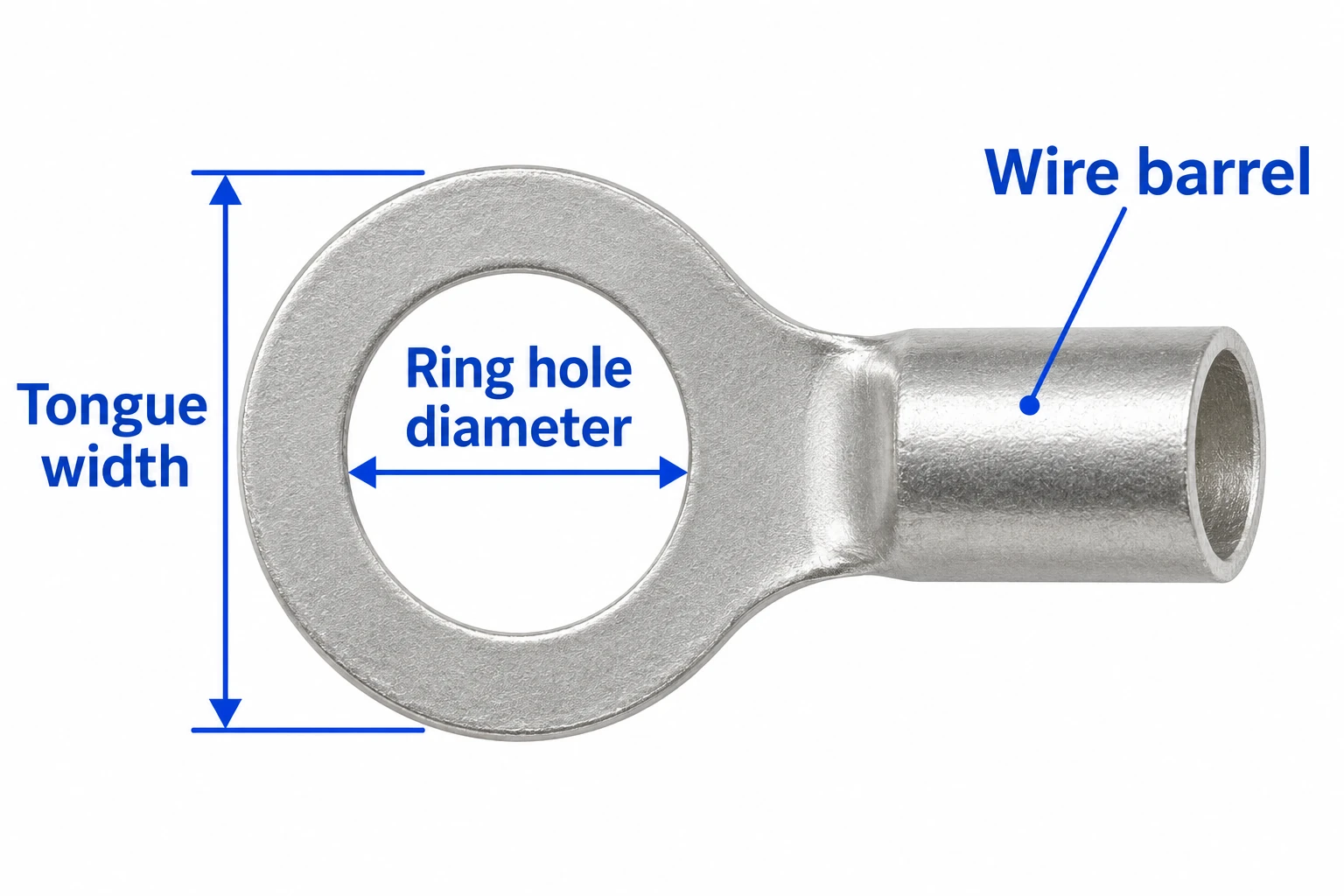
The closed ring fits over the mounting stud, but the opening is only one dimension of the terminal. The outer tongue width and the wire barrel serve different parts of the connection.
| Fit check | Information needed | What it does not establish |
|---|---|---|
| Conductor to barrel | Wire specification, terminal range and tooling requirement | The ring’s suitability for a particular stud |
| Ring to hardware | Stud reference and actual ring-hole drawing | The permitted conductor or crimp process |
| Tongue to mounting space | Outer width and relevant assembly dimensions | The complete electrical or mechanical application rating |
Use these as separate approval fields. A part that passes one check should remain a candidate until the other required interfaces have been reviewed.
The same wire range can have different stud designations
Two external manufacturer records provide a compact example of independent sizing. Both list a 22–16 AWG conductor range, but they identify different stud sizes.
| External product reference | Published wire range | Published stud designation |
|---|---|---|
| 696422-5 | 22–16 AWG | #8 / M4 |
| 130054 | 22–16 AWG | M6 |
These are model-specific examples from the references, not Gaopeng cross-references or interchangeable parts. They demonstrate that a wire-range match cannot identify the complete terminal.
Retain the manufacturer’s exact stud designation, then check the selected drawing for the actual hole and surrounding dimensions. A catalog listing that places metric and imperial designations together applies to that part; it is not a universal conversion rule for every terminal or fastener.
Keep conductor construction and tooling with the barrel choice
The conductor specification should include its size, material and construction. Keep those details with the full terminal reference when requesting a barrel and tooling match. An advertised wire range is one selection input, rather than the whole crimp specification.
Ring-terminal families can use different barrel constructions and insulation formats. A replacement that retains the stud designation can still change the conductor-termination requirement. Confirm the specified tool and die for the selected reference instead of carrying over tooling from a visually similar terminal.
The parts record should identify the terminal and applicable work instructions together. That allows engineering to review a proposed substitution without leaving production to infer the crimp process from sleeve color or a broad size label.
Check the tongue and insulation against the available space
Ring-hole fit does not establish that the outer tongue fits the mounting location. Compare contact width and the relevant terminal envelope with the equipment drawing. Include adjacent hardware and the intended conductor route in that review.
Insulation construction belongs in the same selection. A heat-shrink version is not automatically dimensionally equivalent to a PVC-insulated or uninsulated terminal with a similar ring hole. Retain the required insulation format and the assembled-clearance requirements in the part description.
Where a drawing or supplier listing leaves a dimension unclear, request the complete terminal drawing. Do not use a photograph’s apparent proportions as a measurement or enlarge a hole as an assumed substitute for selecting the correct reference.
Define an HRV part line that engineering can approve
Gaopeng’s HRV heat-shrink ring terminals are published with a copper contact and PE heat-shrink insulation. The product page separates conductor range, ring-hole diameter and contact-width space as selection requirements.
For an HRV enquiry, send the wire specification and the stud or mounting detail together. Identify the required ring-hole fit, maximum tongue envelope and insulation format. Request a full HRV reference and its drawing against those requirements, with the corresponding tooling information.
Once the reference is confirmed, retain those fields on the order line and list quantities by variant. A later replacement can then be checked against the original conductor, hardware and space requirements. The purchasing description remains traceable even when several terminals share a sleeve color or nominal wire range.