Match spade connector sizes using the male-tab width, tab thickness and the conductor range of the wire barrel. The first two dimensions define the mating interface with a female receptacle. The wire range describes a separate termination requirement. A match on only one of these fields leaves the connection incompletely specified.
This guide uses “spade connector” for a flat-blade quick disconnect. If a drawing instead means a fork-shaped terminal, resolve that terminology before ordering; its size reference belongs to a different connection geometry.
A width reference for spade connector sizes
The manufacturer quick-disconnect overview in the references lists several tab widths. The examples below show four of those values with approximate inch equivalents. They help interpret size descriptions, rather than define a universal list of interchangeable terminals.
| Tab width example (mm) | Approximate inch equivalent |
|---|---|
| 2.79 | 0.110 |
| 4.75 | 0.187 |
| 5.21 | 0.205 |
| 6.35 | 0.250 |
Keep the selected part’s drawing and tolerance requirements with its nominal size. A rounded dimension in a listing is an identification aid, not a mating approval. The table also leaves tab thickness and conductor range unspecified; neither can be filled in from width alone.
Match the female receptacle to both tab dimensions
The female receptacle needs to match the intended male tab’s width and thickness. These are separate dimensions on the mating interface. Measuring across the wide face gives a different value from measuring the blade edge.
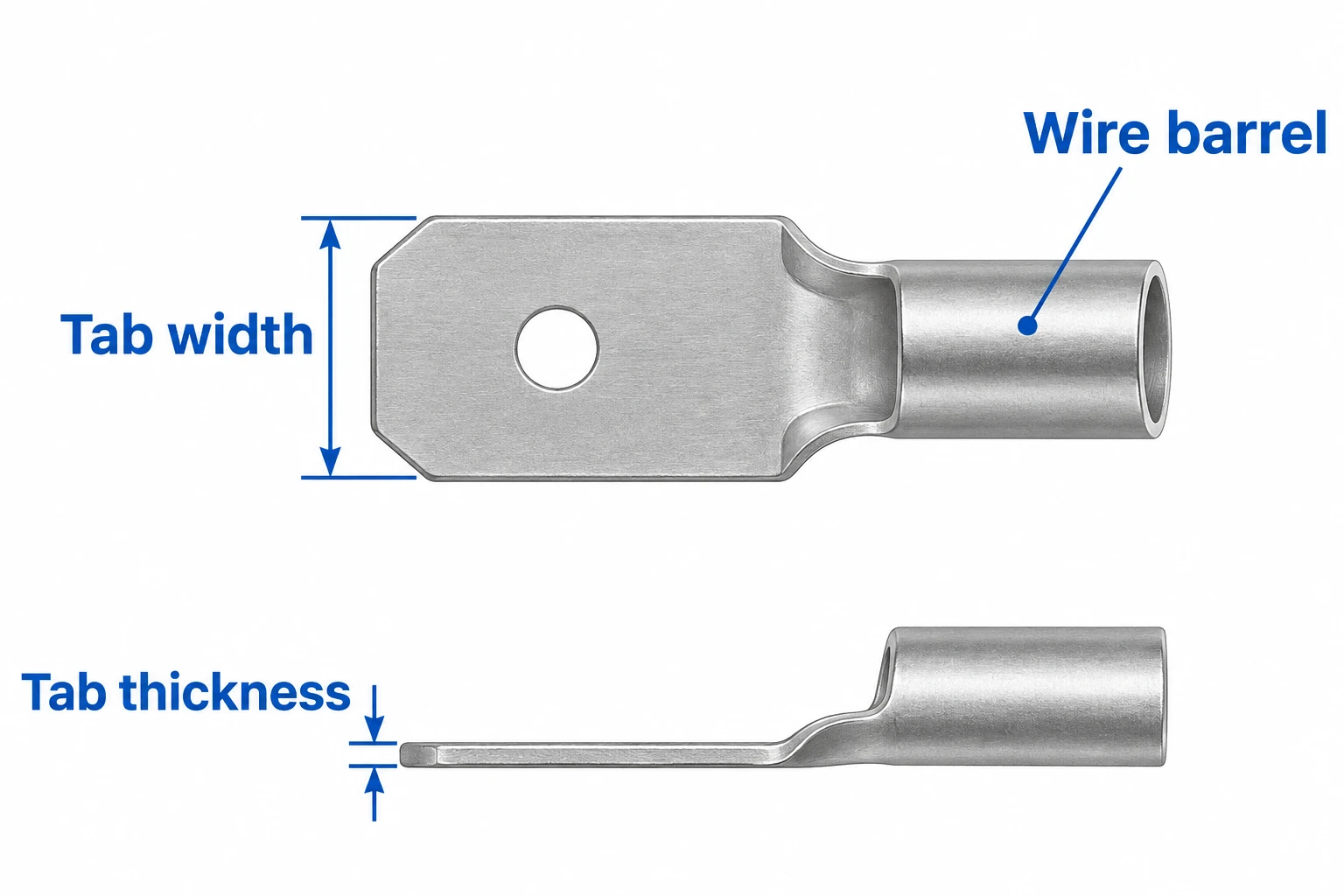
Record both contact references when purchasing a pair. Where the drawing includes additional mating or locking features, retain those requirements as well. A photograph showing a similar flat blade does not establish that the proposed receptacle belongs to the intended connection.
For a replacement, obtain the existing male contact reference or its dimensional drawing. Ask for a matching female reference against that information. An enquiry that says only “female spade for a 6.35 mm tab” still leaves the tab thickness and other part-specific conditions unresolved.
Choose the wire barrel independently
The barrel receives the conductor and must be selected with its required crimp tooling. This is a different interface from the male tab and female receptacle. The same tab-width description should therefore not be treated as a universal wire-gauge range.
One external manufacturer’s product, reference 280081-2, illustrates the separate fields: it lists a 6.35 mm tab width, a 0.81 mm mating thickness and an 18–13 AWG wire range. Those values describe that exact part. They do not establish a Gaopeng equivalent or the wire range of every 6.35 mm tab.
For the conductor side, provide wire size, material and construction together with the terminal reference. Confirm the barrel and specified tooling for that combination. Keep the tooling requirement in the parts record so a terminal substitution does not silently change the assembly process.
Check the insulated assembly’s envelope
Insulation construction and clearance are additional selection requirements. Compare the space around the assembled male and female contacts, including the sleeves and the required connection envelope. The metal tab width is not the total width of an insulated connection.
For heat-shrink versions, retain the selected terminal’s installation-process requirements with its reference. A sleeve color or heat-shrink description does not identify the full conductor range, mating geometry or electrical rating. Use the applicable product documentation for those fields.
A supplier comparison should therefore show two interfaces and the surrounding envelope: tab to receptacle, conductor to barrel, and insulation around the assembled connection. That keeps a physically similar substitute from being approved on appearance alone.
Apply the two-interface check to Gaopeng HMDD terminals
Gaopeng’s HMDD heat-shrink male spade connectors are described with a brass contact and PE heat-shrink insulation. The product page explicitly asks buyers to match male-tab width and thickness with the intended female receptacle.
The conductor-side selection remains separate. Provide the required wire barrel and crimp-tool information, and identify both contact references when buying a mating pair. Include a drawing or the relevant dimensional requirements and the clearance around the assembled insulation.
A precise enquiry might specify the required mating tab dimensions in one field and the conductor specification in another, then request the corresponding HMDD and female-contact references. This is a specification format, not a recommendation for an undocumented combination.
List the quantity for each confirmed version and the delivery destination. Request the drawings and application-specific documents needed to confirm the pair. Procurement then has a defined terminal order, while engineering retains the evidence for both the mating and wire-termination decisions.