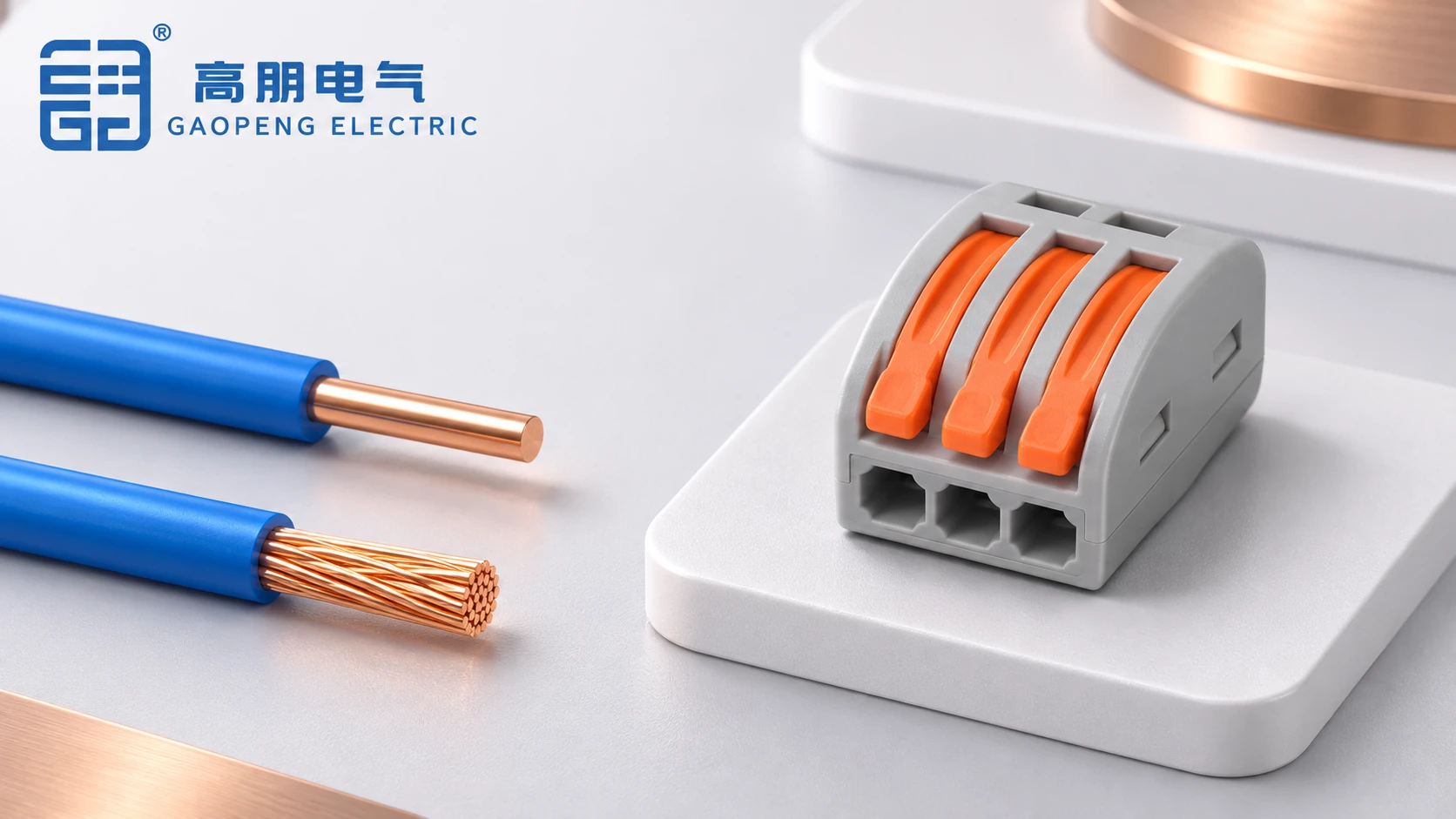
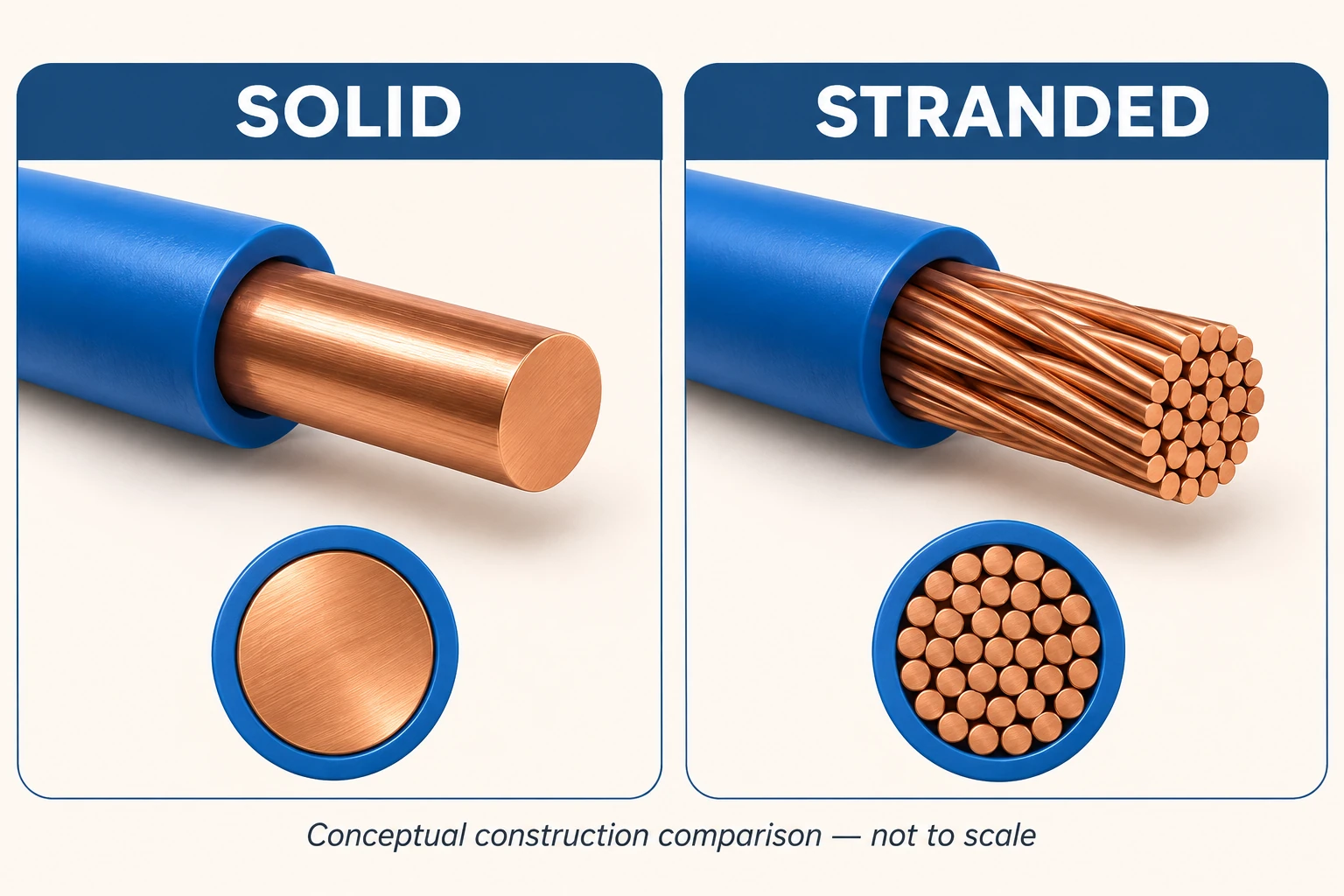
Stranded wire uses multiple smaller wires to form a conductor; solid wire uses a single conductor. Stranded construction generally offers greater flexibility. When comparing stranded vs solid wire for a connector, however, the deciding question is which conductor constructions the exact connector accepts—not which wire is universally better.
A change in construction needs its own compatibility check, even when the nominal wire size stays the same. Record the actual wire specification, connector reference and preparation requirements together before approving a substitution.
Stranded vs solid wire: the construction difference
The terms describe the conductive metal inside the insulation. In its discussion of copper network cabling, Fluke Networks distinguishes a single solid conductor from a conductor made of multiple strands. It also explains why stranded cable is more flexible, while solid cable is more rigid.
That construction distinction is useful for selection. It is not a basis for assigning a general current rating, fatigue life or permissible bend radius to an unidentified wire.
| Question | Solid construction | Stranded construction |
|---|---|---|
| What forms the conductor? | One continuous wire | Multiple smaller wires forming a conductor |
| How does flexibility generally compare? | More rigid | More flexible |
| What must the connector documentation identify? | Acceptance of the actual solid conductor and size | Acceptance of the actual stranded or fine-stranded construction and size |
| What remains application-specific? | Wire rating, routing and termination requirements | The same questions, including any movement requirements |
Connector acceptance belongs to the exact model
A connector’s operating mechanism does not provide its complete acceptance specification. A lever, screw or push-in entry is a visible feature; it does not establish every compatible wire construction, size or preparation method.
As one manufacturer-specific example, WAGO’s documentation for its named 221 connector models distinguishes solid, stranded and fine-stranded conductors and gives acceptance ranges for those categories. The useful lesson is the structure of the documentation: conductor construction is an explicit input. Those ranges apply to the identified products and cannot be assigned to a similar-looking Gaopeng connector.
Use the selected connector’s own documentation to resolve the actual combination. If a drawing, instruction or supplier confirmation does not identify the proposed conductor, a visual resemblance to another product cannot fill that gap.
The same approach applies to conductor preparation. Do not add a ferrule or tin an end on the assumption that it makes every stranded wire acceptable. Confirm the required or permitted preparation for the particular terminal and wire combination.
Record what changes when substituting a wire
A useful substitution record separates unchanged information from changed information. Begin with the original wire reference and proposed replacement, then compare the conductor material, nominal size, solid or stranded construction, insulation and outside diameter.
These are distinct fields. Southwire’s cable data, for example, lists conductor size, strand count, conductor diameter and insulated outside dimensions separately. Keeping the gauge unchanged does not establish that all the other dimensions or construction details are unchanged.
Add the exact connector reference and its accepted conductor categories. Identify the preparation instruction that applies to the replacement, including any permitted end treatment. Record which facts have been confirmed and which remain unresolved; “same wire size” should not close a construction-related question.
If the proposed change is intended to improve flexibility, keep that requirement in the wire-selection review as well. Generic stranded construction does not provide a documented repeated-flex rating for a particular cable. The application still needs a suitable wire specification and connector arrangement.
Specify each wire in a mixed-conductor enquiry
For a connection involving different constructions, describe each incoming wire separately. A hypothetical enquiry might involve one solid copper conductor and one stranded copper conductor, with both nominal sizes already identified in the project documents. The enquiry still needs an exact connector configuration that accepts that pair.
Gaopeng’s lever wire connector listing asks for connection count, conductor construction and the cross-section of each wire. It also asks for the physical arrangement, installation space, electrical requirements and environmental conditions. These inputs let the supplier review the requested configuration; they do not mean every listed lever connector accepts every combination.
Ask for the proposed order reference and the applicable conductor and preparation information. If the selected variant’s acceptance is not confirmed, leave the combination unresolved rather than approving it from the lever action or housing shape. The purchasing decision is complete when the specific wires and the specific connector are matched by documented requirements.
References
Fluke Networks — Stranded vs. Solid Wire Cable
WAGO — Conductor categories for named 221 connector models
Southwire — SPEC 10000 construction and dimension fields