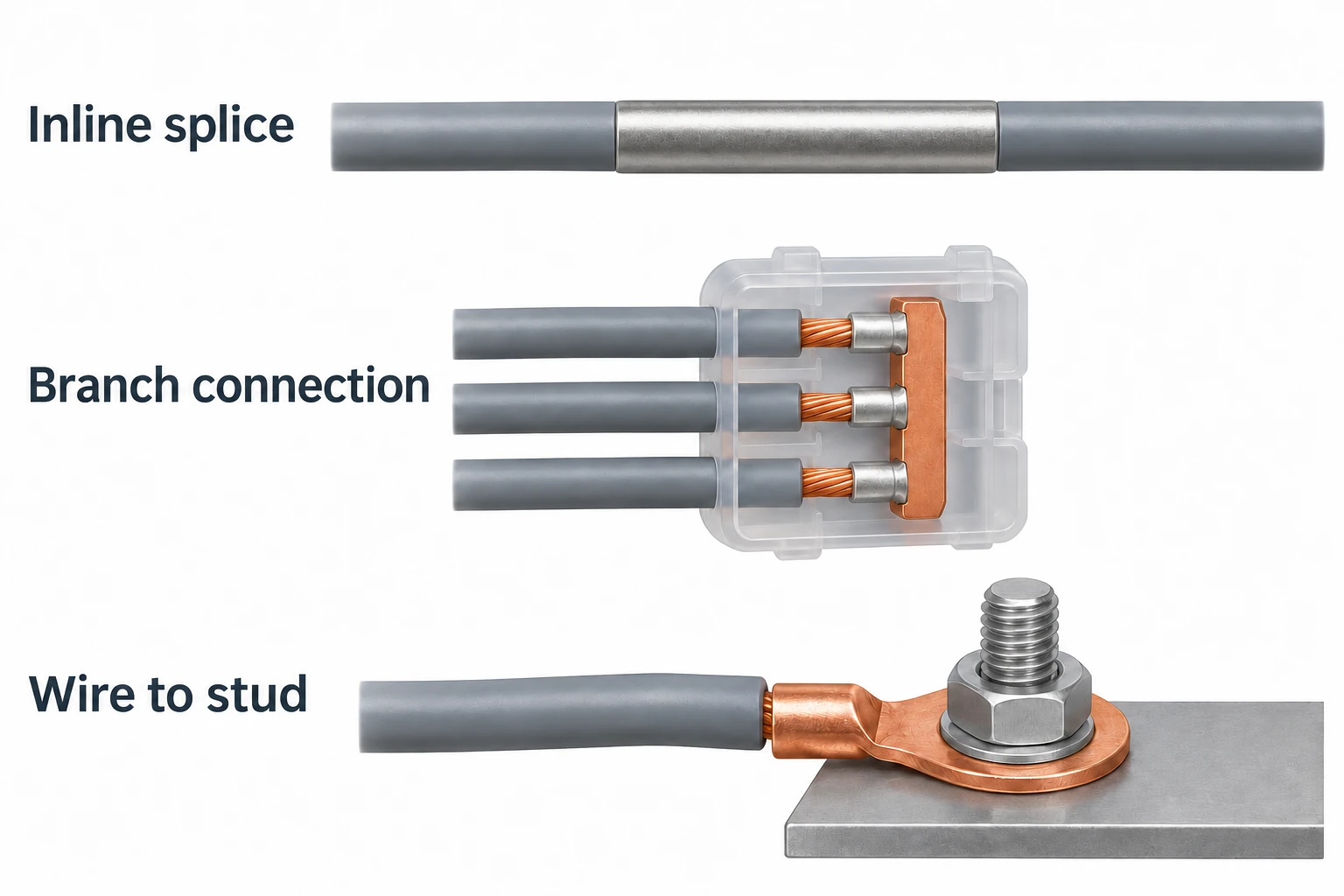
Common wire connector types include twist-on connectors, push-in connectors, lever connectors and crimp connectors. A useful selection starts with two questions: what must be connected, and how will the conductor be retained? A straight wire splice, a branch connection and a connection to a stud are different requirements, even when the same wire size appears on the drawing.
For OEM wiring and purchasing, compare the complete connection requirement before comparing prices. The connector family narrows the search; the exact conductor, part reference and application conditions determine whether a proposed item belongs on the approved parts list.
Wire connector types: separate the connection from the mechanism
“Connector type” can describe either a connection arrangement or its retention method. A butt splice describes an end-to-end connection. A ring terminal describes an end that attaches around a stud. Neither name, by itself, defines all the tooling, conductor or environmental requirements.
Twist-on, push-in, lever and crimp describe how a connector retains the conductors. These terms answer a different question from whether the assembly needs an inline splice, a branch or a detachable interface. Combining both descriptions makes an enquiry more precise: “heat-shrink crimp butt connector for these two conductor specifications” identifies the intended arrangement and construction.
Keep that distinction in the bill of materials. Replacing a part because it accepts a similar wire size can change the connection arrangement, the assembly method or the way maintenance staff can disconnect it. A substitute needs review against the original requirement.
Compare retention methods by the decision they require
The following matrix is a buying aid, rather than a rating chart. Each method still requires an exact manufacturer reference and its applicable documentation.
| Method | How the family is distinguished | Selection question |
|---|---|---|
| Twist-on | A shell and internal spring act on the conductors as the connector is twisted | Is this exact conductor combination permitted for the selected model? |
| Push-in | Conductors enter a retention mechanism without twisting the connector | Which conductor constructions and reuse conditions does this model permit? |
| Lever | A lever opens and closes a conductor clamp | Are the required conductor types and service operations covered? |
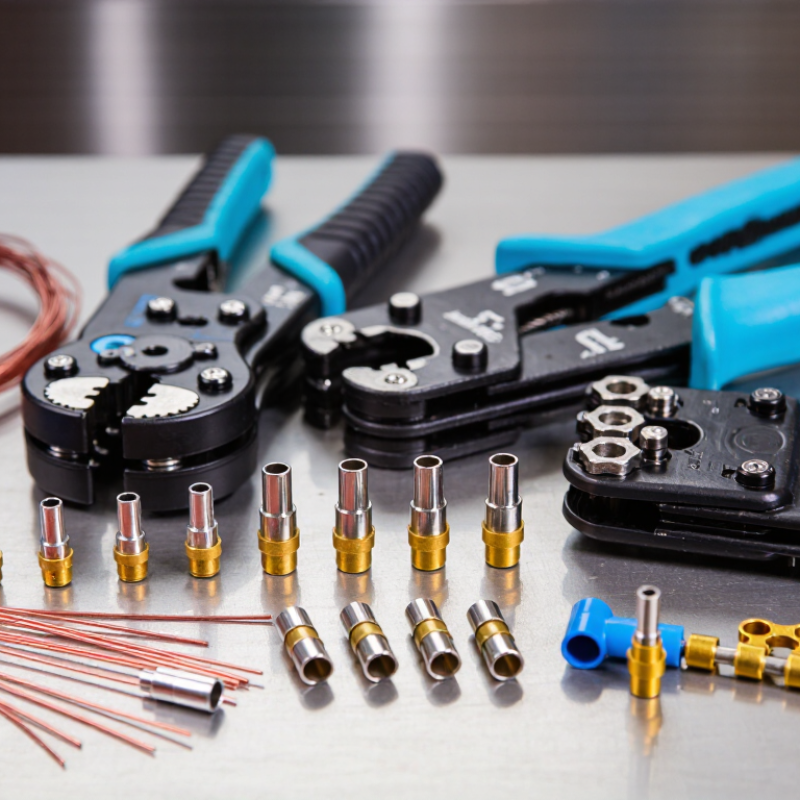
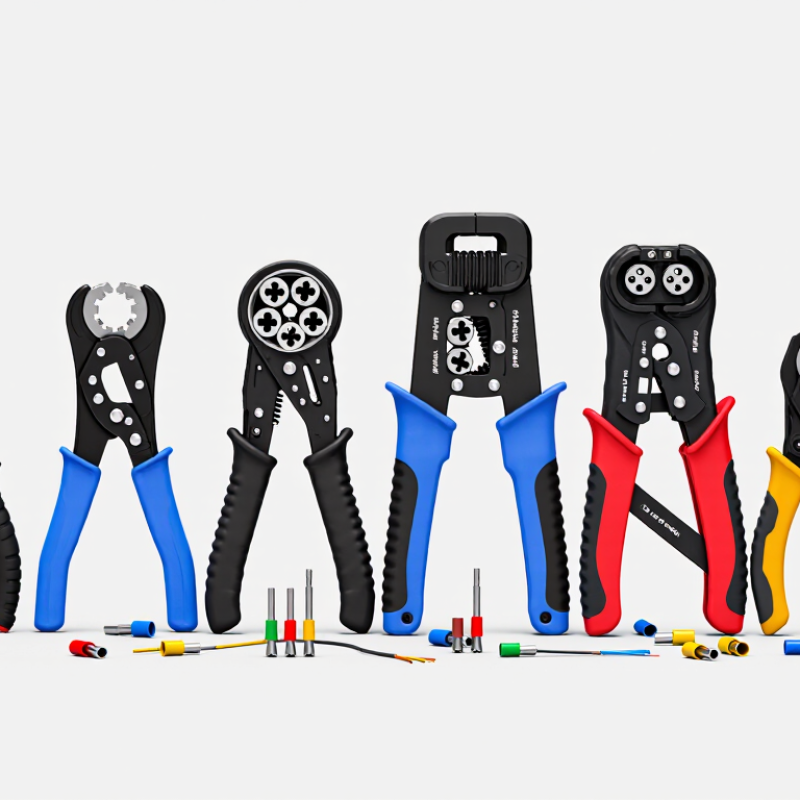
| Crimp | Tooling compresses a metal connection around the conductor | Are the barrel, wire and die specified as a compatible combination? |
| Screw connection | A screw-operated clamping part holds the conductor against a contact surface | Can the specified conductor preparation and screw access be achieved in this assembly? |
A family description does not establish a shared voltage rating, conductor range or environmental capability. Those values belong to the exact part and its documented conditions. Keep them as separate comparison fields so a visually similar replacement cannot silently change the specification.
Conductor construction can change the shortlist
Solid, stranded and fine-stranded conductors should be identified explicitly. “Accepts stranded wire” is incomplete when the product documentation also limits strand construction or conductor size. The official push-in product details listed in the references provide an example: they distinguish conductor constructions and set different reuse conditions.
Lever connectors also have model-specific conductor limits. The existence of one series accepting several conductor families does not establish the same compatibility for every lever connector or for an unverified substitute.
For purchasing, retain the wire specification from the assembly drawing and request a matching connector reference. If the two ends of a splice use different conductors, describe both ends. Do not reduce that information to a single maximum wire size or a connector color.
Decide how the assembly will be serviced
Service access should be part of connector selection. If technicians need to remove or change conductors, ask whether the selected part permits that operation and under which conditions. Reuse is a documented product property, rather than a benefit that can be assigned to an entire connector family.
Environment is another separate requirement. State whether the joint needs protection from moisture or other exposure, and identify the documentation required by the project. A sleeve, a clear housing or an adhesive layer does not independently establish suitability for an outdoor, buried or sealed assembly.
Resolve these requirements before requesting interchangeable quotations. Otherwise, suppliers may quote different constructions under the same broad description, leaving procurement to compare prices for parts that serve different purposes.
A documented butt-splice example for an OEM enquiry
Gaopeng’s heat-shrink butt connectors illustrate a specific construction within the wider connector selection. The product page identifies a copper contact, a polyolefin sleeve and a dual-wall construction with adhesive.
For this range, an enquiry should specify the size and construction of both conductors, the required barrel and crimp profile, and the installation environment. State any sealing requirement separately so the selected version and supporting documentation can be reviewed. The published materials describe the product; they do not establish a universal sealing rating.
Keep one comparison record for each proposed variant: connector reference, conductor details, connection arrangement, retention method, required tooling, service conditions and documentation. Add the quantity and delivery destination for the quotation. This gives engineering and purchasing a common basis for approving the part and comparing supplier responses.