Choose wire nut sizes by the complete conductor combination permitted for the exact connector model: the number of wires, their sizes and their construction. Cap color helps identify a product, but it does not establish which wires can be joined inside it. A physical cap-size chart answers a different question from a wire-combination chart.
For a purchasing decision, keep both records. Use the manufacturer’s combination documentation to check the wires, then use the dimensional drawing to check the available installation space. Neither record replaces the other.
Read wire nut sizes as complete combinations
A combination describes each conductor in the connection. For example, “two #14 AWG conductors and one #12 AWG conductor” describes a different bundle from “three #14 AWG conductors.” These are notation examples, not statements that either bundle is permitted in a particular cap.
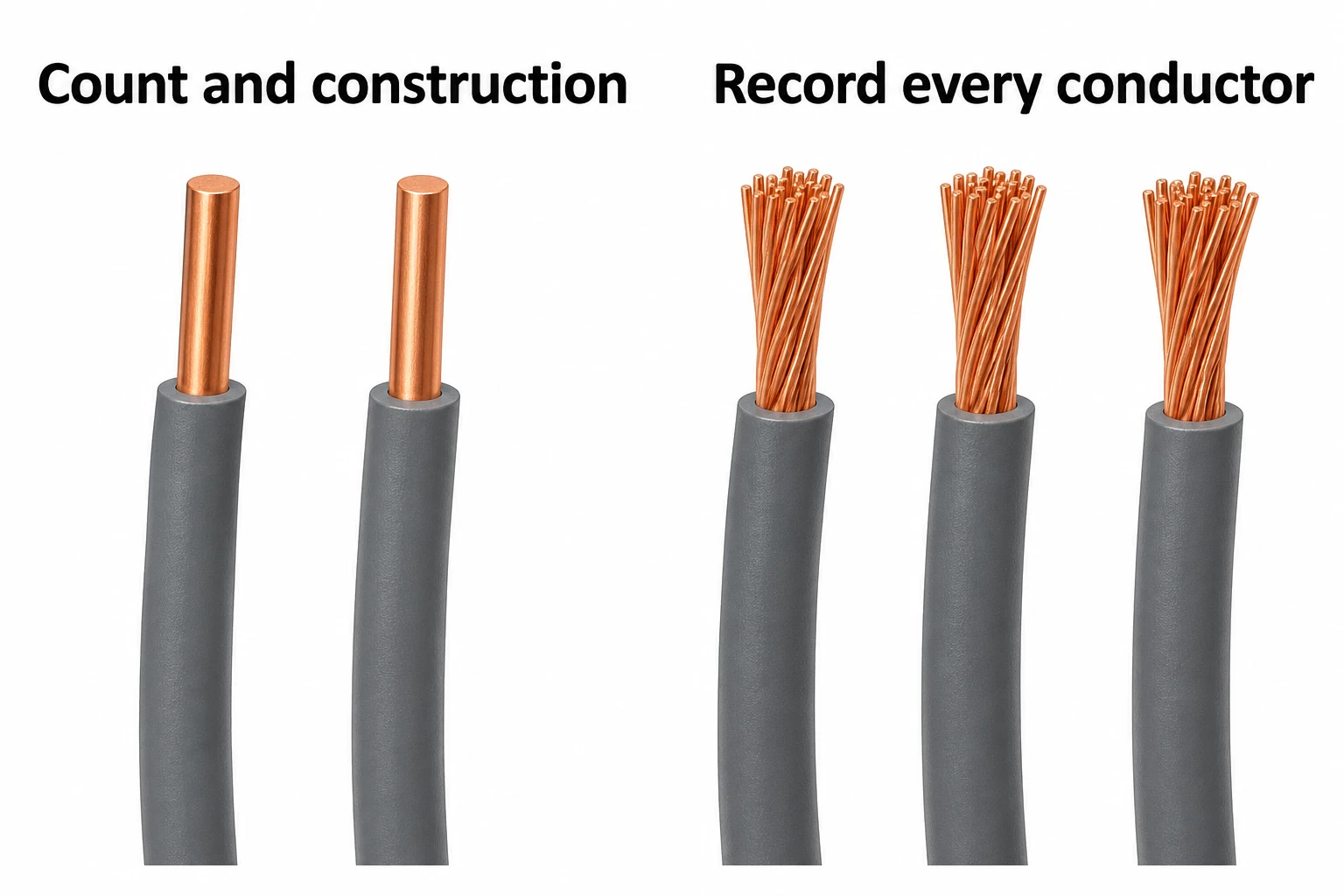
The wire construction also matters. A description that specifies stranded wire should not be shortened to the gauge alone. Keep any manufacturer conditions concerning material, strand construction and preparation with the combination record.
A broad advertised range is useful for finding a candidate model. It should not be treated as permission to assemble every possible wire count or mixed-gauge combination between the listed endpoints. Find the complete combination in the applicable documentation, or request confirmation for the exact bundle before selecting the part.
What an advertised range does—and does not—tell you
Two external manufacturer examples show why a wire nut size chart must retain the model identity. The official 71B product page advertises a minimum combination of two #22 AWG stranded conductors and a maximum of two #16 AWG conductors. The 73B product page describes a minimum of one #18 with one #20 AWG conductor and a maximum of two #14 AWG conductors.
These examples belong to different products. They are not equivalent parts, Gaopeng specifications or a recommendation to substitute one for another. Their value is in showing how an advertised range includes wire counts as well as gauges.
When reading a listing, distinguish its headline range from its detailed combination instructions. If a distributor provides only a color and a broad AWG range, request the manufacturer’s full reference and current documentation. Do not fill the missing information with a combination from a different brand or series.
Gaopeng SP cap dimensions: an envelope reference
The Gaopeng SP twist-on wire connector nuts page lists six references with different dimensions and conductor-combination entries. The table below preserves its L, B and C dimensional labels. All dimensions shown are in millimeters.
| SP reference | Color | L (mm) | B (mm) | C (mm) |
|---|---|---|---|---|
| SP1 | Grey | 15.0 | 8.5 | 6.7 |
| SP2 | Blue | 17.5 | 10.1 | 7.4 |
| SP3 | Orange | 22.1 | 12.6 | 9.9 |
| SP4 | Yellow | 24.5 | 13.7 | 11.0 |
| SP6 | Red | 26.5 | 16.0 | 12.7 |
| SP8 | Grey | 32.2 | 18.3 | 12.8 |
Use these values to identify the cap reference and compare its envelope against the relevant drawing. Confirm the drawing’s dimensional directions before using B or C as a clearance requirement. The table is not a wire-capacity chart and does not establish a permitted conductor combination.
Why color and unit shortcuts cause selection errors
Both SP1 and SP8 are listed as grey, yet their published dimensions differ. An order for “grey wire nuts” therefore leaves the required SP reference unresolved even within this one product range. Record the full model instead of using color as the purchasing specification.
Keep wire-size units separate from cap dimensions. Millimeter dimensions describe the component envelope; they do not describe conductor cross-section. Likewise, converting a nominal wire size between measurement systems does not create a manufacturer-approved combination.
The public SP table’s conductor-arrangement column does not explicitly label its conductor units. Request confirmation of those units and the complete supported combination for the selected reference. The dimensional values above can be used as published without turning ambiguous conductor entries into a guessed AWG or mm² chart.
Send a sizing enquiry that identifies the whole bundle
For each connection, list the number of conductors, each conductor’s size and unit, material and construction. Include mixed sizes explicitly. Add the intended SP reference, the available space and the installation environment, then request confirmation against the applicable combination documentation and preparation instructions.
For bulk purchasing, keep quantities separate by confirmed reference and include the delivery destination. Ask for the required drawing and product-specific documentation with the quotation. This leaves engineering with a traceable compatibility decision and purchasing with an unambiguous item to order.