Choose zip tie sizes using the usable bundle-diameter range, strap length, strap width and locking-head dimensions of the exact part. Length alone does not tell you how large a bundle the tie will secure. The material version and installation requirements also belong in the specification.
For cable management, start with the bundle as it will be arranged in the assembly. Compare that requirement with a supplier’s published dimensional drawing and bundle range, then confirm the selected version before ordering quantities.
The measurements behind zip tie sizes
A cable tie’s dimensions answer several separate fit questions. Keeping them in separate fields prevents a long strap from being mistaken for a large usable loop, or a narrow strap from being mistaken for a small locking head.
| Field | What to record | What it helps check |
|---|---|---|
| Length | The dimension defined by the product drawing | The complete tie reference and available strap geometry |
| Strap width | The width of the band, distinct from its head | Fit through the intended route or mounting feature |
| Head envelope | Head width, height and other relevant drawing dimensions | Clearance around the lock and adjacent components |
| Bundle range | The published minimum and maximum usable bundle dimensions | Whether the intended bundle falls within the part’s stated range |
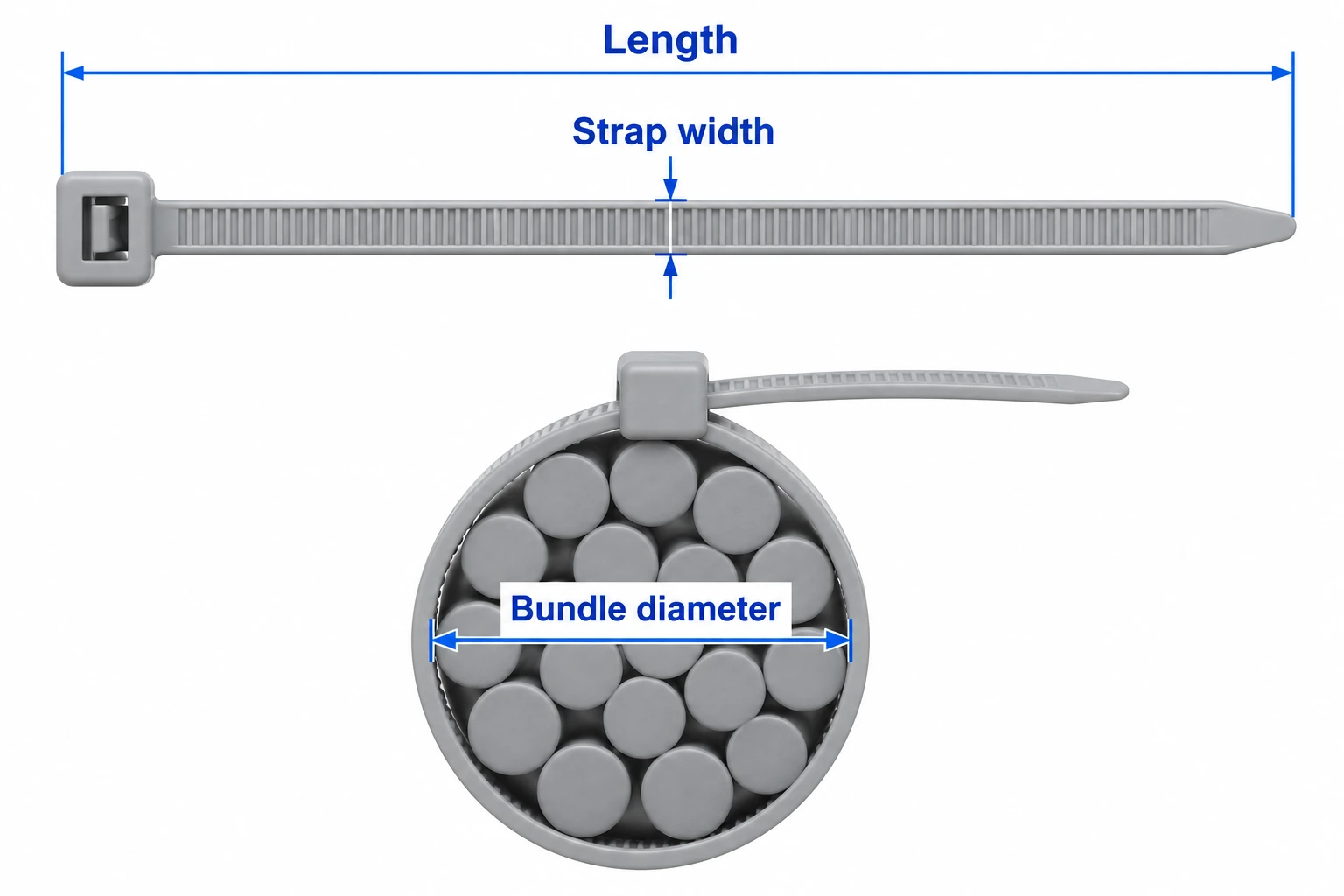
Record units alongside every value. Where an assembly drawing specifies a slot or passage, compare it with the relevant part dimension rather than assuming the strap and head have the same width.
Why circumference is only a starting calculation
For a perfectly circular bundle with a diameter of 40 mm, its geometric circumference is π × 40, approximately 125.7 mm. That calculation describes the path around the bundle. It does not identify the length of a usable cable tie.
The tie must also engage its locking head and leave the length needed for the specified installation method. Those requirements depend on the selected design. There is no universal extra-length allowance in this calculation, and a nominal 125.7 mm tie is not a recommendation for that example bundle.
Use the calculation to understand the geometry, then select against the manufacturer’s usable bundle range. Dividing a tie’s total length by π reverses only the circle calculation; it does not account for its closure. It therefore cannot replace the published maximum bundle diameter.
A product record shows why the fields stay separate
The external manufacturer record for reference 111-05007 lists a 200 mm length, 4.6 mm strap width and a bundle range of 1.5–50 mm. These are specifications for that exact reference, rather than Gaopeng dimensions or a universal size class.
The example makes two purchasing checks visible. Strap dimensions and usable bundle range occupy separate fields in the record. Head clearance requires its own drawing check. The stated bundle range also remains a separate selection field, even when total length is known.
Retain the complete product reference with those values. A description such as “200 mm tie” omits width, head geometry, usable bundle range and material version.
Check the actual bundle shape and tie design
An irregular bundle should not be reduced to an assumed circular diameter without checking the intended routing and contact geometry. Send a drawing, measured envelope or sample arrangement when the shape makes a single diameter misleading. Ask the supplier which published bundle definition applies to the proposed part.
Special head designs need their own review. The parallel-routing DH-Series record in the references identifies a different arrangement. Its basic size description does not settle each loop’s usable fit; buyers should request the corresponding arrangement drawing.
Dimensional fit also leaves other requirements unresolved. State the environmental exposure and required material version independently. Color or strap dimensions do not establish temperature, UV or fire performance. If the project requires a particular rating, request the documentation for the exact version rather than assigning a rating from another tie.
Specify the Gaopeng tie version before requesting quantities
Gaopeng’s nylon self-locking cable ties are listed for cable bundling. The product page asks buyers to provide bundle diameter, strap width and strap length, together with material and environmental requirements.
A useful order specification also includes the required color, installation method and trimming requirements. Add a drawing or sample reference where head clearance or bundle shape controls the choice. Request the dimensional record and any application-specific evidence needed to confirm that version.
Keep quantity and packaging requests separate for each confirmed reference, and include the delivery destination. A shared dimensional and material record gives the buyer a clear basis for comparing quotations and checking a proposed replacement. A match on strap length alone leaves too much of the cable-management requirement unspecified.