



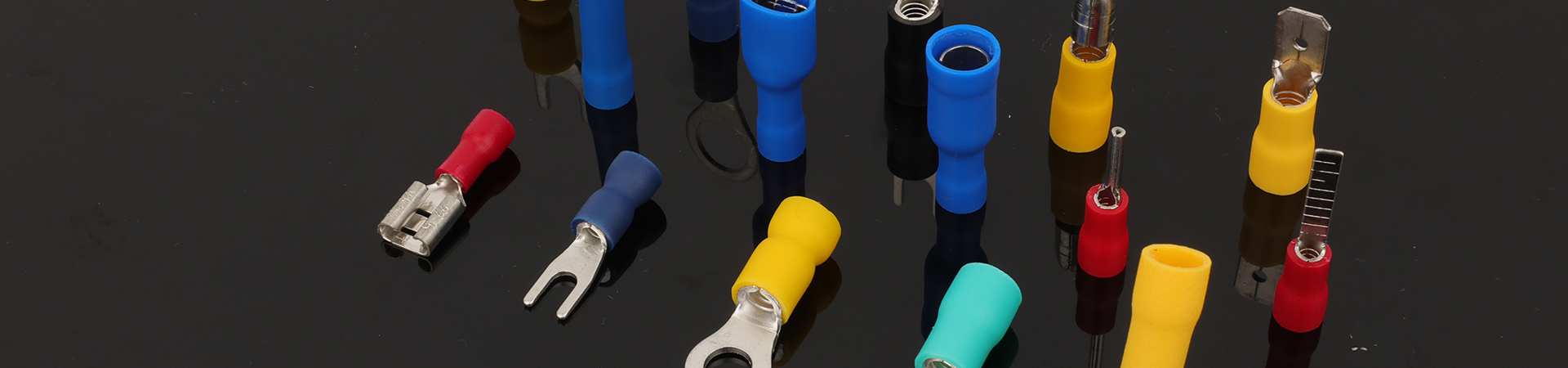
Heat Shrink vs PVC vs Nylon Insulated Terminals: Which One Survives Your Application?
- The three insulation families at a glance
PVC (polyvinyl chloride), nylon (polyamide 6 or 66) and heat shrink (cross-linked polyolefin with adhesive lining) sit on the same crimp barrel but cover three very different performance envelopes. The shortcut is this: PVC is the budget indoor choice, nylon is the heavy-duty industrial choice, and heat shrink is the only choice when water can reach the joint.
| Property | PVC Insulated | Nylon Insulated | Heat Shrink Waterproof |
| Temperature class | -25 C to +75 C | -40 C to +105 C | -55 C to +125 C |
| Water / moisture | Not rated | Splash-tolerant only | Sealed (IP67 typical) |
| Mechanical strength | Standard | High (resists repeated insertion) | High after shrink + adhesive set |
| Chemical / fuel exposure | Limited | Good vs oils, fuels, mild solvents | Excellent (adhesive seals barrel) |
| Typical price index | 1.0x (baseline) | 1.4 - 1.8x | 2.2 - 3.5x |
| Gaopeng model prefix | RVEE / SV / MDD / FDFD / MPD / FRD / BV | RNYBV / SNB / MDFNY / FDFNY | HMDFNY / HFDFNY / HMPD / HFRD |
- When PVC is the right answer
Specify PVC insulated terminals when the joint lives indoors, stays dry, and never sees more than +75 C. Typical B2B applications: lighting control panels, building automation, low-voltage distribution boxes, appliance assembly, and 12 V / 24 V automotive sub-harnesses that sit inside the cabin (not in the engine bay). PVC is also the right choice for distributors who need a full color-coded SKU range at the lowest possible unit cost - red, blue and yellow sleeves Snap into automated assembly tools without re-tooling.
Where PVC fails: anywhere oil mist, brake fluid or condensation can collect. The plasticizer in PVC migrates over time, the sleeve hardens, and cracks open along the barrel after 18 - 24 months.
- When nylon is the right answer
Nylon (PA 6 or PA 66) is the workhorse for industrial environments. It pushes the upper service temperature to +105 C, resists most petroleum-based oils and fuels, and is mechanically tough enough to survive a technician yanking the wire to test the joint. We recommend nylon for: engine-bay automotive harnesses, machine tool cabinets, conveyor and packaging machinery, agricultural equipment, and any panel where the ambient runs above 75 C.
Nylon is also the right specification when your end customer demands UL 486A-486B or IEC 60998-2-1 listings for higher operating temperatures - the certification is significantly easier to pass than with PVC.
Where nylon fails: prolonged submersion. The polyamide itself absorbs water (up to 9% by weight), which over years can soften the sleeve. For wet applications, move to heat shrink.
- When heat shrink waterproof is the only answer
Heat shrink waterproof terminals (Gaopeng HMDFNY, HFDFNY, HMPD and HFRD families) use a cross-linked polyolefin sleeve with an internal hot-melt adhesive. After crimping, a heat gun set to roughly 120 C shrinks the sleeve onto the wire insulation and melts the adhesive into the barrel, producing a sealed joint typically rated IP67. Specify this family for: marine and shipboard wiring, trailer and RV harnesses, outdoor LED installations, solar PV junction wiring, irrigation pumps, snow plows, and any application that will see condensation, salt spray or wash-down.
The cost premium is real - typically 2 to 3.5 times the equivalent PVC SKU - but the failure mode you avoid (corrosion creep up the strands, hidden resistance rise, eventual fire risk) is severe enough that experienced harness builders never compromise on this category.
- Decision matrix - which one should you order?
Use this short matrix when you write your bill of materials:
- Indoor, dry, under 75 C, lowest cost: PVC insulated (RVEE / SV / MDD series).
- Indoor or outdoor enclosure, hot or oily, 75-105 C, UL panel: nylon insulated (RNYBV / MDFNY series).
- Outdoor, wet, marine, automotive engine bay, solar, agricultural: heat shrink waterproof (HMDFNY / HMPD series).
- Mixed harness on one assembly line: standardize on nylon as the default and add heat shrink only at the wet interface - this keeps the BOM short while protecting the critical joints.
Frequently Asked Questions
Q1. Can I use a PVC insulated terminal outdoors if I add electrical tape over it?
No. Tape provides mechanical wrap, not a sealed barrier. Water wicks up the wire strands behind the tape, corrodes the copper, and resistance rises silently for months before the joint fails. For outdoor exposure, the only correct fix is a heat shrink adhesive-lined terminal.
Q2. What temperature does a heat gun need to shrink the Gaopeng heat shrink family?
Approximately 120 C surface temperature on the sleeve, applied evenly for 8 to 15 seconds depending on size. Stop when the sleeve has fully collapsed onto the wire insulation and a small bead of clear adhesive appears at both ends - that is your visual confirmation of a sealed joint.
Q3. Are nylon insulated terminals UL listed?
Our nylon series is available in both UL-recognized and IEC-only variants. State the certification in your RFQ so we quote the correct SKU - lead time and unit price differ between the two.
Q4. Can I mix the three families in one order?
Yes. Most of our B2B customers order a mixed-family carton at the start of a new project to validate each insulation in the actual environment, then standardize on the family that survives the field test. We can split-pack a single carton across PVC / nylon / heat shrink at no extra cost.
Ready to source the right insulation?
Send your environmental specification (temperature range, IP rating, expected service life) to our sales team and we will return a quoted bill of materials within one working day, with samples available before mass production.
Yueqing Gaopeng Electric Co., Ltd. | 280 Wei Er Shi Road, Yueqing, Zhejiang, China | www.cngaopeng.com
About the publisher: prepared by the technical team at Yueqing Gaopeng Electric Co., Ltd., a manufacturer of insulated terminals, heat shrink waterproof connectors, SC copper lugs and electrical tools since 2016. All specifications cited are verified against our internal QC records and the referenced IEC / UL standards.
SEO Metadata (TDK)
| Title (T) | How to Inspect Crimped Insulated Terminals: B2B Importer QC Checklist | Gaopeng |
| Description (D) | Your supplier shipped 100,000 insulated crimp terminals. How do you verify they are actually crimpable? This step-by-step incoming-inspection checklist from Gaopeng Electric covers crimp height, pull-out force, insulation integrity and the eight defects to reject before the lot reaches your line. |
| Keywords (K) | how to inspect crimp terminals, crimp quality inspection, incoming quality check terminals, pull-out test crimp terminal, crimp height tolerance, B2B importer QC checklist, insulated terminal defects, Gaopeng Electric |