The most expensive terminal on your bench is the one that is not there when the line asks for it. The second most expensive is the ten thousand units you bought just in case that are still in the carton two years later. Both mistakes come from the same place: guessing quantities instead of calculating them. We help buyers plan terminal volumes every week, from single projects to full distributor stocking programs. This is the method we use, in plain terms.
How do I count the terminals in one harness or one unit?
Start with one finished item, not a spreadsheet. If you have a sample harness, strip the count from it: every crimped end, every splice, every T-tap, every ground strap. Write the count per terminal type. If the harness has forty crimp points and you need five hundred units, the base number is twenty thousand, before any allowance. If you do not have a finished sample yet, work from the design file and add a category for test leads and repair points, because they always exist in the real build and never exist on the drawing. One real harness, photographed at every station, beats a hundred estimated rows.
What rework or scrap allowance should I add?
Here is where everyone’s number is different, because your allowance should be based on your own scrap, not ours. As a starting point: a mature line on a part the team has crimped before runs around three to five percent. A new line, a new part, or new operators starts higher, around five to ten percent, until you have a few weeks of real yield data. Then let the data set the number: measure rejected crimps over a month and use that. The point of the allowance is not to be safe forever. It is to be right by the third month.
Can I mix sizes in one order?
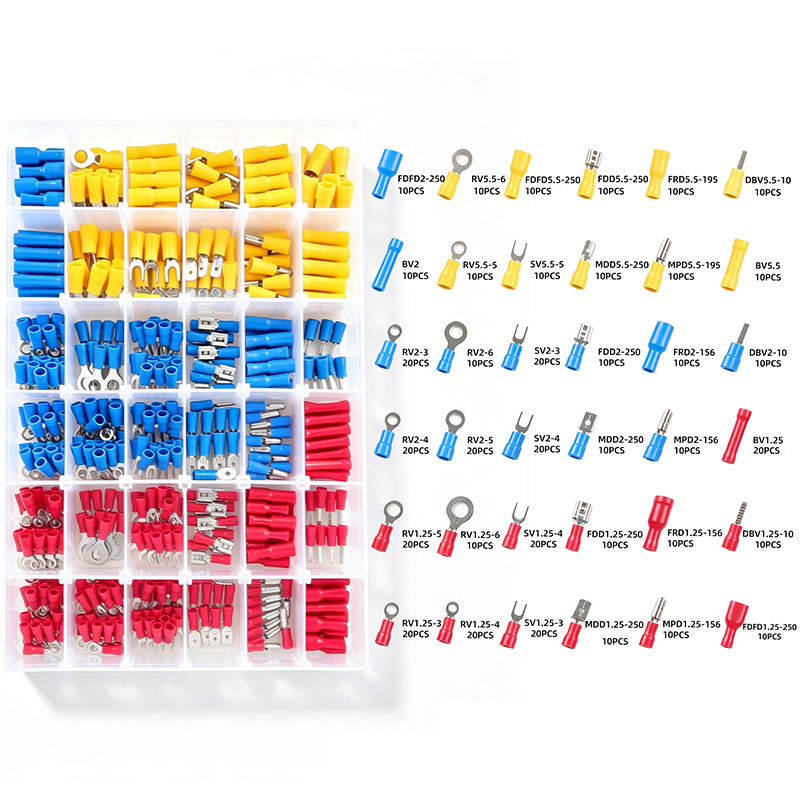
Yes, and you should. Mixed kits are standard practice. For a project, ask your supplier to build the kit around your BOM: the exact sizes and quantities your harness uses, in one box. For a distributor, the usual split is standard multi-size kits for the fast movers plus spot orders for odd sizes. One practical tip from our packing side: if you mix many sizes in one order, put a minimum pack quantity per size. A kit that is short by three connectors of one size is still a short kit, and it stops a build just as reliably as a missing carton.
How should a distributor split stock across sizes?
Use the classic A/B/C split, and let your sales data do the talking. Group A: the roughly twenty percent of SKUs that carry around eighty percent of volume. On general wiring, those are usually the middle sizes, the 16-14, 14-12, and 12-10 ranges, plus the ring and Fork pairs that go with them. Keep two to three months of cover. Group B: one month of cover. Group C, the long tail: quote and make to order. Review the split every quarter. A size that is an A item during harness season is often dead stock by winter, and the money you freed up by moving it down a tier is real money.
What do I do when a project quantity changes?
First, get the change in writing: new quantity, effective date, which line items move. If it is a one-off spike, ask the supplier about a bulk price with an option to return sealed, unopened excess. Not every supplier offers it, but ours does on reasonable terms, and it is cheaper than buying the spike from stock at list price. If the change is a permanent program shift, move that SKU up a tier in your A/B/C list and reset the cover. And if a customer cancels a line, say so early. Half-used production runs can sometimes be re-packaged as standard stock; nobody can help you if you never mention it.
A worked example, so the method is concrete
Take a control-harness program: forty crimp points per harness, five hundred units per month. The base number is twenty thousand terminals per month, before any allowance. Your BOM says twelve of those points are 16-14 Ring Terminals, nine are 16-14 forks, six are 16-14 butts, and the rest are 14-12 across ring, fork, and butt. Multiply each line by five hundred and add five percent on the whole, and the order comes out to roughly twenty-one thousand, split across the lines in the same proportions. One last habit: buy in the supplier’s pack increments. If a size comes in packs of 100, ordering 2,050 leaves fifty loose connectors on the shelf, and the next order starts from a weird number. Round each line up to the pack, and your stock records stay clean.
Yueqing Gaopeng Electric is a terminal manufacturer, founded in 2016, based in Yueqing, with in-house molds and ISO 9001 process control. We help buyers turn a harness drawing or a photo into a full terminal BOM with quantities and allowances, free of charge. Send us your project and we will send back the numbers you can order against.