



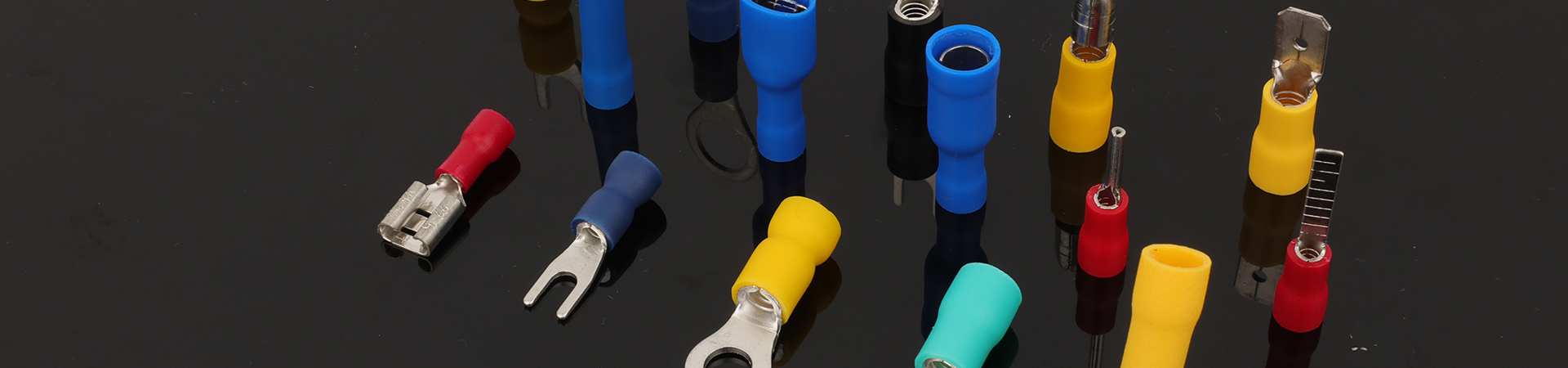
How to Choose the Right PVC Insulated Wire Terminal: A B2B Buyer's Guide to Spade, Ring, Bullet, Fork & Butt Connectors
- What exactly is a "PVC insulated Wire terminal"?
A PVC insulated wire terminal is a crimp-style copper or brass connector that comes pre-sleeved with a polyvinyl chloride (PVC) jacket. The metal barrel grips the stripped wire when crimped; the PVC sleeve covers the barrel, prevents short circuits between adjacent terminals, and acts as a color-coded marker for the wire gauge it is designed for.
Compared with bare (non-insulated) lugs, PVC Insulated Terminals install faster - no separate heat-shrink tubing is required for low-voltage indoor applications - and they meet the touch-safety requirements common in IEC 60204-1 control panels and 12 V/24 V automotive sub-harnesses. PVC is the right insulation choice when the working temperature stays between -25 C and +75 C. Above that range, switch to nylon or heat-shrink insulated versions (a separate Gaopeng product family).
- The five shapes you will actually order - and when to use each
On the Gaopeng product catalog, five PVC insulated families cover roughly 90% of B2B order volume. Here is how to pick between them in one sentence each:
| Terminal Type | Gaopeng Model Prefix | Connection Style | Best B2B Use Case |
| Ring Terminal (Easy-Entry) | RVEE1.25 / RVEE2 / RVEE3.5 / RVEE5.5 | Closed ring around a stud or bolt | Permanent ground bonds, battery posts, distribution blocks where vibration is high |
| Fork / Spade Terminal | SV1.25 / SV2 / SV3.5 / SV5.5 / SV8 / SV14 / SV22 | U-shaped tongue slips under a loosened screw | Terminal blocks and PLC field wiring where technicians need to swap wires without removing the screw |
| Male / Female Spade Quick Disconnect | MDD / FDFD series (1.25 / 2 / 5.5) | Flat-blade plug-and-socket pair | Automotive sub-harnesses, appliance wiring, anything that must be field-serviceable |
| Bullet Connector (Male / Female) | MPD / FRD series (1.25 / 2 / 5.5) | Cylindrical plug-and-socket pair | Motorcycle and powersports harnesses, lighting circuits, low-current signal lines |
| Butt Splice / Butt Connector | BV0.5 - BV38 | Two-sided barrel joining two wire ends in-line | Wire extensions, repair splices, solar DC string assembly inside junction boxes |
Quick rule of thumb most procurement engineers we work with apply: if the joint will never be opened again, use a ring or butt; if a technician will service it monthly, use a quick-disconnect spade or bullet; if the joint is on a screw terminal block, use a fork.
- How do I match the terminal size to my wire (AWG and color code)?
The number after the model prefix - 1.25, 2, 5.5, 8 and so on - is the nominal copper cross-section in square millimeters, which is the international convention. For North American buyers using AWG, the cross-reference below covers the five sizes that account for the bulk of insulated PVC orders. The PVC sleeve color is not decorative; it is a globally recognized wire-range marker.
| Gaopeng Size Code | Wire Range (mm2) | Equivalent AWG | PVC Sleeve Color |
| 1.25 | 0.25 - 1.65 mm2 | AWG 22 - 16 | Red |
| 2 | 1.04 - 2.63 mm2 | AWG 16 - 14 | Blue |
| 3.5 / 5.5 | 2.63 - 6.64 mm2 | AWG 12 - 10 | Yellow |
| 8 | 6.64 - 10.5 mm2 | AWG 10 - 8 | Yellow (oversleeve) |
Picking a terminal one size larger than your wire is a common mistake. An oversized barrel cannot be crimped to a gas-tight joint, even with a calibrated tool, and the resistance climbs over time. If you are between sizes, choose the smaller code and confirm with a pull-out test (the typical industry threshold is 220 N for 1.25 mm2 and 580 N for 5.5 mm2, per IEC 60352-2).
- What should a B2B buyer ask the supplier before placing the PO?
Most disputes after delivery come from specification gaps that were never written into the order. Before you confirm your PO, send the supplier these eight items in writing - we keep a one-page PI template available for buyers:
- Barrel material and plating: pure copper (preferred for ring/butt high-current) or brass; tin-plated for corrosion resistance.
- Insulation material confirmed as PVC, RoHS 2.0 compliant, halogen-free if your end market requires it.
- Temperature class - standard PVC = 75 C; ask for the supplier's UL or IEC test report if you sell into regulated markets.
- Crimp tool family: the terminal series, the die profile, and the recommended crimp height tolerance (typically +/-0.05 mm).
- Packaging: bulk bag (1000 pcs), reel for automated machines, or color-mixed assortment box for distributor channels.
- Lot traceability: batch number printed on the carton, with material certificates available on request.
- MOQ, lead time and tooling cost if you require a custom barrel length or a private-label PVC sleeve color.
- Certifications you will need at customs clearance: CE, RoHS, REACH, and where applicable UL listings.
- PVC vs. nylon vs. heat-shrink - when should I switch insulation?
Stay with PVC when the application is dry, indoor, and under 75 C ambient. Move to nylon insulated terminals when the panel runs hotter (105 C class) or when you need higher mechanical strength against repeated insertion. Move to heat-shrink waterproof terminals - Gaopeng's HMDFNY and HMPD families - when the joint will see condensation, salt spray, or outdoor weather, which is typical for marine harnesses, PV junctions and trailer wiring.
- Why source PVC insulated terminals from Gaopeng Electric?
Yueqing Gaopeng Electric Co., Ltd. has manufactured terminals and connectors from our facility on Wei Er Shi Road in the Yueqing electrical industry cluster since 2016. We design and build our own crimping molds in-house, which lets us hold barrel-wall tolerance under 0.05 mm and ship full-color-coded mixed cartons in as little as 12 days. We hold ISO 9001, CE and RoHS certifications, and our SGS test reports are available to verified buyers upon request.
OEM and ODM buyers can specify private-label PVC sleeve colors, custom printed cartons, and consignment-stock terms for forecasted orders. A typical first sample lead time is 5 working days; mass production lead time runs 15 - 25 working days depending on plating volume.
Frequently Asked Questions
Q1. Can PVC insulated terminals be used outdoors?
PVC is not rated for continuous UV exposure or moisture. For outdoor enclosures, use a heat-shrink waterproof terminal (Gaopeng HMDFNY or HMPD series) or install the PVC terminal inside an IP65 or higher housing.
Q2. What is the difference between a ring terminal and a fork terminal?
A ring terminal forms a closed loop and cannot pop off the stud, which is required for vibration-prone joints such as battery posts. A fork terminal has an open U-shape so it can be installed or removed without fully unscrewing the terminal block - faster for field service but it can vibrate loose if used on moving equipment.
Q3. Do I need a calibrated crimp tool for PVC insulated terminals?
Yes for production volume. A ratcheting tool matching the terminal series (color-coded jaw) ensures the barrel reaches the correct crimp height. Hand pliers are acceptable only for prototypes.
Q4. Are Gaopeng PVC terminals UL-listed?
We supply both UL-recognized and IEC-only versions - specify which you need so the correct SKU and packaging are quoted; lead time and unit price differ.
Ready to place your B2B inquiry?
Send your bill of materials to our sales team for a quotation within one working day. Mention this guide and we will include a free PVC color-code wall chart with your sample shipment.
Yueqing Gaopeng Electric Co., Ltd. | 280 Wei Er Shi Road, Yueqing, Zhejiang, China | www.cngaopeng.com
About the publisher: prepared by the technical team at Yueqing Gaopeng Electric Co., Ltd., a manufacturer of insulated terminals, heat-shrink waterproof connectors, SC copper lugs and electrical tools since 2016. All specifications cited are verified against our internal QC records and the referenced IEC / UL standards.