Anyone who has ordered terminals from a Chinese factory knows the scene. The quote says one thing, the sample says another, and the size code printed on the barrel says a third. Most of the time nobody made a mistake. Part numbers are simply not as universal as buyers hope. We have designed and built Crimp Terminals in Yueqing since 2016, and mismatched part numbers are still the number one cause of wrong-order complaints we hear about in this trade. Here is how to read a terminal part number the way we read it on our own production floor, and how to make sure the part that ships is the part you meant.
What do the letters at the front of the code usually mean?
The first one or two letters of a model number usually describe the product family. Ring terminals often start with R, Fork or spade terminals with F, butt connectors with B, solder-seal or solder-insulation sleeves with S, and closed-end or cord-end ferrules with an E or a K. The catch is that these letters are each factory’s own convention. One supplier’s RNB might stand for ring, nylon, series B. Another supplier’s RNB might not stand for anything you can translate. Letters are a hint, not a promise. Treat them the way you would treat a nickname: useful, but never sufficient. The actual part gets confirmed against a drawing or a spec sheet, every time.
What do the numbers, like 16-14, actually tell you?
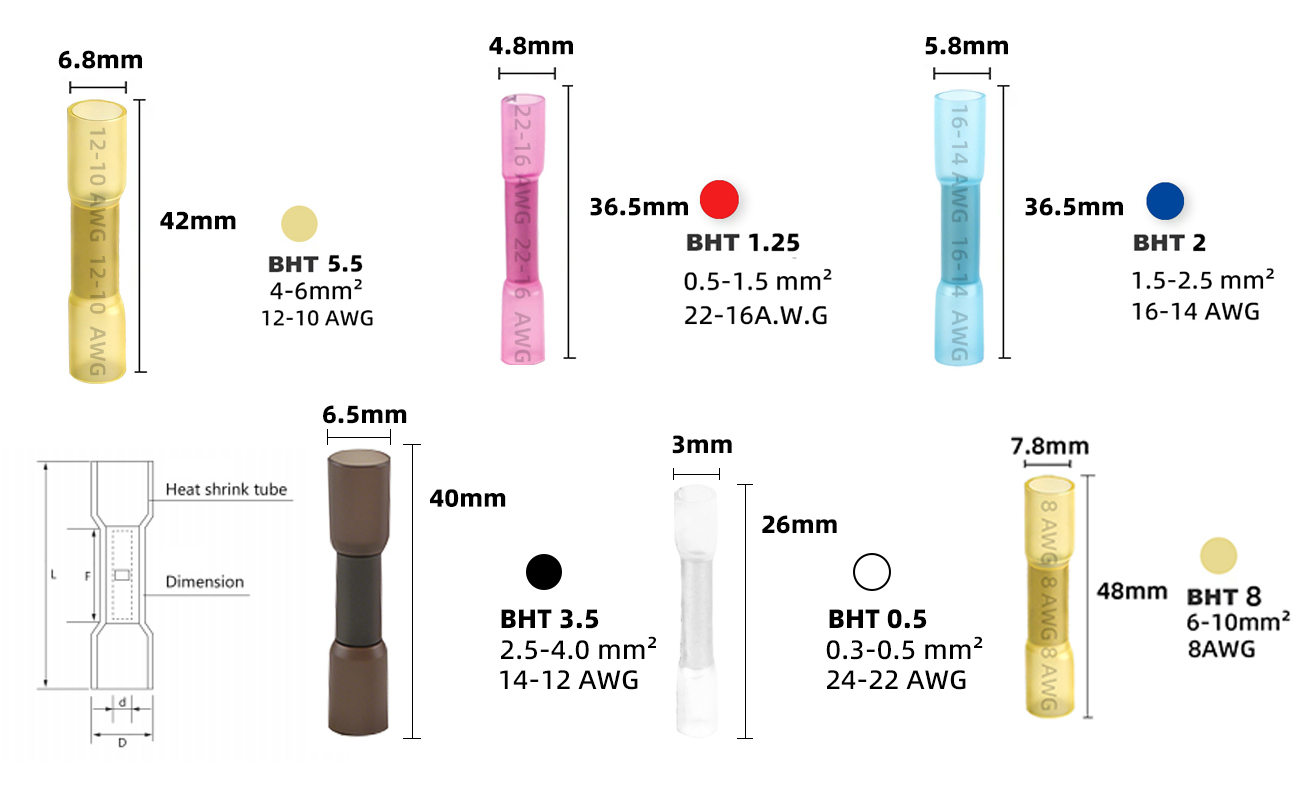
This is the part that matters most to your order. A code like 16-14 or 12-10 describes the range of wire the crimp barrel accepts. If you see 16-14 AWG printed on a connector sleeve, the barrel is sized for 16 or 14 AWG wire, which in metric terms is the 1.5 to 2.5 mm2 band. Many of our barrels carry both systems at once, because we ship to buyers who order in AWG and buyers who order in mm2, and the part is the same either way.
Some model numbers end in a second small number that is just a series or variant code, not a size. A 16-14 terminal and its 16-14A sibling can look identical and still be different crimp profiles. If you are not sure what a trailing digit means, ask before ordering. It is a two-minute question on the supplier side, and it saves a full carton of the wrong part on yours.
Where are the insulation type and the material listed?
Usually nowhere in the code, and that is worth repeating. A lot of model numbers tell you the shape and the size, but not what the insulation is made of, what temperature it is rated to, or how flame-resistant it is. The same 16-14 ring terminal can exist in PVC, in nylon, or as a heat-shrink version, with an almost identical barrel underneath. The differences that matter in the field are the temperature rating, the flame-retardant grade, and the crimp cross-section, and none of them is reliably encoded in the letters and numbers on the sleeve.
The spec sheet is the document you should be comparing, not the part number. When you request a quote, ask for the spec sheet per line item. When you receive samples, check the sample against that sheet, not against the code.
Is any of this standardized across the industry?
Honestly, no. There is no single industry standard for crimp terminal model numbers. Standards do exist for the physical side: conductor cross-section, current and voltage ratings, pull-out force, and the test methods behind them. But the code a factory prints on the sleeve or the box is house style, and every factory has its own. That is normal, and it is not a red flag. It simply means a part number by itself is not an order.
What makes two terminals interchangeable is geometry: barrel inner diameter, crimp profile, insulation length, and the ratings on the sheet. If you can match those four things, the letter code does not matter at all.
By the way: the sleeve color is not a size
One confusion we see in inquiries: buyers assume that blue means one size and yellow means another. On some product lines, factories do assign colors to sizes, but the assignments differ from factory to factory and sometimes from batch to batch. A blue sleeve on our product and a blue sleeve on a competitor’s product can be two different sizes entirely. If color coding matters for your line, agree it in writing on the order: which size gets which color, and make sure the spec sheet carries the same table.
A simple check before you release a bulk order
- Ask for a size cross-reference table for each product family. A good supplier keeps one and sends it without being asked twice. We keep ours current with every new mold.
- Order samples of every size and insulation type in the order, not just one. A sample is the only document that cannot lie to you.
- Measure one sample’s barrel against your actual wire, stripped to length. Fit is a physical fact, and it takes ten seconds with a caliper.
- If you are replacing an existing part, send a photo or drawing of the old part and ask for a cross-reference. Our engineers do this comparison every day, and it is free.
- Write the confirmed part number, size, insulation, color, and quantity on the order. As per last time is not a specification.
We are Yueqing Gaopeng Electric, a terminal manufacturer in Yueqing, the electrical parts heart of China, making crimp terminals since 2016 with our own mold shop in-house and ISO 9001 control around the line. If you have a part number you are not sure about, send it to us with a photo of the part you have. We will tell you what we think it is and what our equivalent is, before you commit to a single box.