The short answer
If your wiring sits in a hot, oily, or vibrating spot — engine bays, pumps, industrial machinery — nylon-Insulated Terminals are the safer bet. If you are wiring junction boxes, control panels, or appliances where space is tight and budgets matter, PVC-insulated terminals do the job well and cost less. Both crimp the same way, and both are perfectly fine for ordinary indoor wiring. The difference only shows up when the environment gets rough.
What insulated terminals actually are
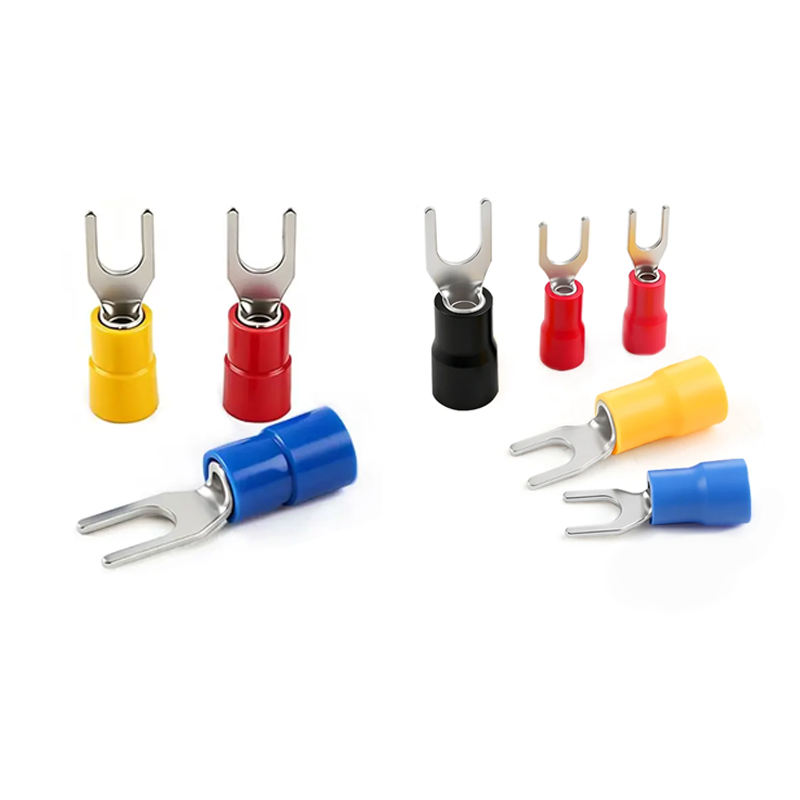
An insulated Crimp Terminal is a metal connector — usually tin-plated brass or copper — wrapped in a coloured plastic sleeve. You strip a wire, slide it into the barrel, and squeeze it with a crimping tool. The sleeve insulates the connection, so you do not need separate tape or heat shrink. The colour is not decoration: red, blue, and yellow tell you which wire gauge the terminal fits. Red suits 22–16 AWG, blue suits 16–14 AWG, and yellow suits 12–10 AWG. That colour code is the same across nylon and PVC lines, which keeps ordering simple.
Ring, Fork, bullet, butt — the shapes matter too
Once you have settled on the insulation material, you still need the right shape for the connection point. Ring terminals wrap a stud completely and stay put under vibration. Fork (spade) terminals slide in and out without removing the nut — handy for test points and serviceable connections. Bullet connectors make quick-disconnect plugs for wiring harnesses. Butt connectors splice two wires end to end. The material decision — nylon or PVC — applies across all of these shapes, so you rarely have to compromise: both insulations are available across the common terminal shapes.
What nylon brings to the table
Nylon sleeves are harder and tougher than PVC. They are also slightly translucent, so you can see the crimp inside. At Gaopeng we rate our nylon-insulated terminals for –20°C to +80°C, and the material shrugs off oil, moisture, and vibration — the three things that kill ordinary connections in vehicles and machinery. If a terminal is going to live under a hood, inside a motor housing, or anywhere it gets splashed, nylon is the default choice.
Where PVC shines
PVC is softer and more flexible. That is a feature, not a flaw: it lets the terminal bend where a stiff nylon sleeve might crack, and it copes with repeated movement in cramped spaces. PVC terminals are also more affordable, which matters when you are wiring a whole panel or a production run of appliances. Their glossy finish is not just looks — the smoother surface sheds water a little more easily in damp indoor areas, though neither material is a substitute for a properly sealed waterproof connector when real moisture is involved.
Nylon vs PVC at a glance
|
Property |
Nylon insulated |
PVC insulated |
|
Toughness |
Harder, impact-resistant |
Softer, more flexible |
|
Oil and moisture resistance |
Good, resists oil and vibration |
Moderate, indoor-friendly |
|
Appearance |
Semi-translucent, matte |
Glossy, opaque |
|
Typical wire range |
AWG 22–10 |
AWG 22–10 |
|
Colour code |
Red / Blue / Yellow |
Red / Blue / Yellow |
|
Best for |
Automotive, industrial, oily or hot spots |
Panels, appliances, tight spaces, budget runs |
How to choose — a quick decision path
- Hot, oily, or vibrating environment? Go nylon.
- Tight bend radius or cramped panel? Go PVC — the flexibility helps.
- Outdoor or moisture-prone spot? Nylon handles more, but if water is a real risk, use a proper waterproof connector instead.
- Large order and cost-sensitive? PVC keeps the unit price down.
- Not sure? Send the application details to the factory — both materials are available, and a wrong guess costs more than a five-minute conversation.
A practical example: two panels, two choices
Picture two control panels. Panel A sits in a workshop next to a machine that sprays cutting oil, and its wiring runs near a small motor that gets hot. Nylon terminals are the obvious call — the oil resistance and the temperature rating match the environment. Panel B is a distribution box in a clean office riser, wired once and never touched; the installers are working in a tight cabinet with sharp bends. PVC terminals give them the flexibility to route the last few centimetres without stressing the joints, and the lower unit price matters when the order runs to a few hundred pieces. Same factory, same wire, two different materials — and both are the right answer in their own box.
Quick FAQ
- Can I mix nylon and PVC terminals in one panel? You can, but keep it intentional. If a service technician sees one material, they will assume it was chosen for a reason; mixing without one just invites questions later.
- Does the colour code change between nylon and PVC? No. Red, blue, and yellow mean the same AWG ranges in both lines, so one habit works everywhere.
- Are nylon terminals waterproof? No. They resist oil, moisture, and vibration, but they are not a sealed waterproof joint. If water can pool on the connection, use a heat-shrink waterproof connector instead.
- Can you customise colour or barrel length? Yes — the moulds are designed and made in-house, so custom sleeves, colours, and packaging are standard OEM/ODM work for us.
A word about the factory behind them
We are Yueqing Gaopeng Electric Co., Ltd., a terminal manufacturer founded in 2016 and certified to ISO 9001:2015, with CE, RoHS, and SGS compliance on our product lines. Our insulated terminals use tin-plated brass barrels with crimp resistance under 0.5 mΩ, rated for 20 A continuous current, and the nylon sleeves are pre-crimped in-house so the quality is consistent from batch to batch. We also do OEM and ODM, and since the moulds are designed and made in our own factory, custom colours, barrel lengths, and packaging are normal conversations for us.
Bottom line
Both materials make solid, reliable connections when crimped properly. Match the material to the environment — nylon for rough conditions, PVC for tight and budget-conscious builds — and you will rarely think about it again.