Q1: What’s actually different between the three insulations?
All three are crimp terminals — the metal part is a tin-plated copper barrel with a ring, fork, hook, or Bullet shape on the other end. The difference is the sleeve wrapped around the barrel:
- PVC (vinyl)— a soft, flexible plastic sleeve. It’s the cheapest insulation, bends easily, and is fine for indoor, dry, low-vibration work. Its weakness: it’s softer and less durable, and it doesn’t like heat or cold extremes.
- Nylon— a tougher, harder plastic sleeve that’s pre-insulated onto the barrel. Nylon resists abrasion, oil, and solvents better than PVC, and it stands up to more heat. Our nylon-sleeved terminals are rated for -20°C to +80°C and are tested at 20 A continuous current with crimp resistance under 0.5 mΩ.
- Heat shrink— a polyolefin tube that shrinks around the joint when heated, with adhesive inside that melts and seals it. This is the only one of the three that gives you a genuinely waterproof, sealed connection. It’s the most expensive, and it needs a heat source to install.
Q2: Which one handles heat, vibration and chemicals best?
Nylon beats PVC on all three. That’s why most automotive and industrial harness work moved to nylon decades ago — PVC gets brittle in the cold, softens under heat, and degrades when it meets oils and fuels. Nylon keeps its grip, and the color-coded sleeves (red, blue, yellow) are molded to hold the barrel firmly so the crimp doesn’t twist.
Heat shrink is the outright winner for moisture and vibration, because it’s the only one that seals. Once shrunk, the adhesive-lined tube locks out water, salt, and dirt, and it adds strain relief at the joint. A Heat shrink terminal on a boat, a trailer, or an outdoor machine will outlast the equipment around it.
Q3: When does PVC actually make sense?
PVC terminals are not junk — they’re the right tool for a specific job. Use them when:
- The connection is indoors, dry, and stationary — appliances, lighting, distribution boards, control cabinets.
- You want maximum flexibility in tight spaces or moving cable runs (PVC is the most bendable of the three).
- Cost matters and the environment is benign. PVC is the most economical option, and for a high-volume appliance manufacturer, that difference adds up.
The rule of thumb we give customers: if you’d be embarrassed to find the terminal corroded or cracked in five years, don’t use PVC. If it lives inside a protected box, PVC is fine.
Q4: When should I upgrade to heat shrink?
Upgrade to heat shrink when any of these is true:
- The joint can get wet — marine, automotive underbody, outdoor lighting, irrigation, pool equipment.
- The wire runs in an engine bay or anywhere with vibration and temperature cycling.
- You’re building harnesses that must pass salt spray or moisture tests — a sealed joint is a tested joint.
- You want to eliminate corrosion callbacks on products with a warranty.
Our heat shrink range covers -45°C to +125°C (crimp type) and survives over 1,000 hours of salt spray testing, with 30 kV dielectric strength on the insulated types. If your application sheet says “outdoor” or “water-resistant,” that’s your answer.
Q5: How do I read the color coding?
The industry color code is consistent across nylon and PVC, and heat shrink follows the same logic:
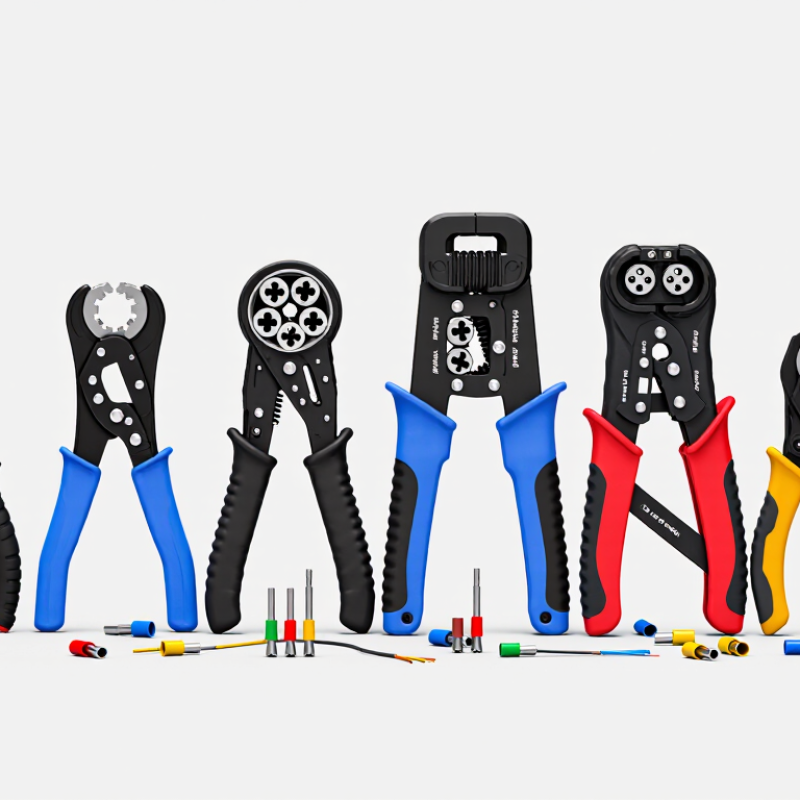
- Red— 0.5–1.5 mm² (22–16 AWG)
- Blue— 1.5–2.5 mm² (16–14 AWG)
- Yellow— 4.0–6.0 mm² (12–10 AWG)
The color tells you the wire range the terminal accepts. It’s not decoration — it’s how a technician can grab the right terminal without measuring. Our nylon and PVC ranges run from AWG 22 to AWG 10, and every box is packed with a clear gauge table so line workers don’t guess.
Q6: So what should I actually stock?
Here’s what we recommend to distributors and OEMs, based on what actually sells:
- Nylon as your workhorse— ring and fork terminals in red/blue/yellow cover most panel, appliance, and automotive work. This should be the biggest part of your stock.
- PVC for cost-sensitive, indoor-only lines— same shapes, same color code, lower price point. Useful as an alternative SKU when the buyer’s application is genuinely dry and stationary.
- Heat shrink for the “premium” and outdoor lines— butt connectors and ring/fork terminals in the same color code. Higher margin, fewer warranty claims, and increasingly a requirement in marine, RV, and solar work.
If you’re an OEM specifying terminals for a product, send us the environment and the wire sizes — we’ll tell you honestly which insulation you need. If you’re a distributor, stocking the three-tier approach means you never tell a customer “we don’t have that.”