When a buyer asks for a terminal to their own drawing the conversation eventually moves to the tooling, because the part does not exist until the dies and the molds exist. Three questions always come up: who pays for it, who owns it, and what happens when the program ends. We cut our own tooling and run our own molds in Yueqing, and we have handled all three answers across the programs we run, so this article is the straight version of how each arrangement works and what we write into the agreement. It is the part of an OEM conversation that is easier to settle in week one than in year three.
What tooling actually is for a terminal
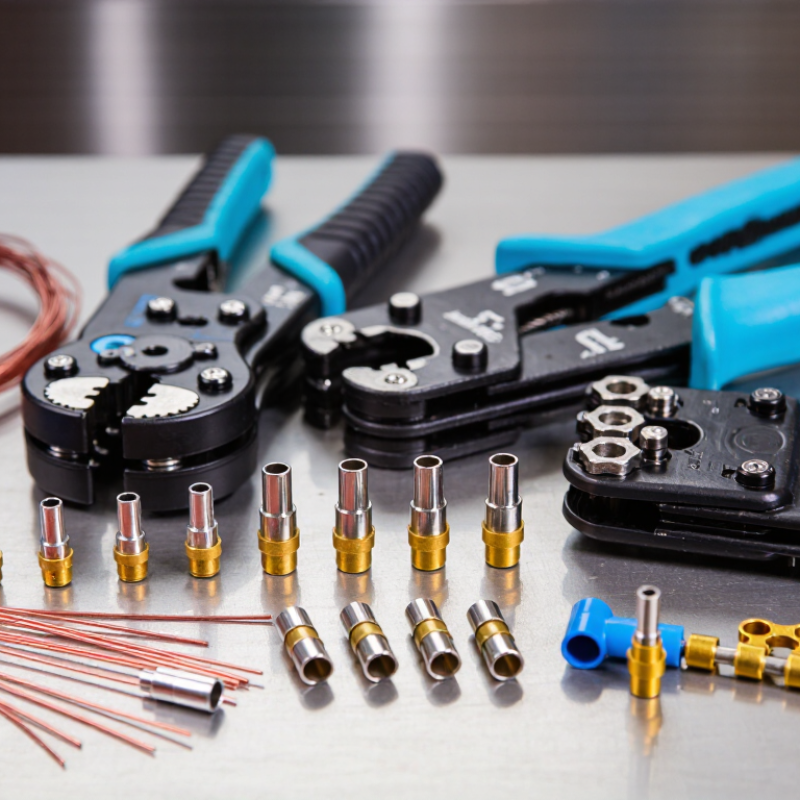
For a non-insulated terminal the tooling is the forming line: the dies that take flat copper and make the barrel, the flat, and the pin, plus the crimp die set if the part is crimped rather than solid. For an insulated terminal there is a second set, the injection mold that makes the polymer body around the metal, and the mold follows the geometry of the body, which is why a simple barrel looks cheap and a shaped body does not. If the part is a molded connector the insert mold and the shell mold are separate sets again. The cost follows the sets. A forming die is one number, an injection mold is another, and a custom connector is the sum of its molds. When we quote a part we price the tooling on its own line so the two never get mixed.
Three ways the cost gets handled
First, the buyer pays the tooling line up front and the unit price runs at the standard volume rate from the first piece. Second, the tooling is amortized into the unit price over an agreed quantity, and the price steps down as the quantity is reached. Third, the part runs from a mold we already have, there is no new tooling at all, and the part prices at the standard rate from the first piece. The honest comparison is in the total, not the label. Up-front cost is best when the quantity is certain, because the buyer owns the set and the price never carries it. Amortized is best when the quantity is ramping, because the buyer is not paying for a ramp that may not happen. And the existing mold is best of all when the part is one we already run. We will tell you which of the three your part falls into before you commit to any of them.
Who owns it, and what the exit looks like
Ownership follows the payment in most of our programs. If you paid the tooling line up front you own the set, and the agreement says so in writing: we store it, we mark it to your program, and if the program ends the set is transferred or reworked as the agreement allows. If the tooling was amortized into the price the ownership stays with us and you hold the right to the part for the agreed program life. The exit is where the ambiguity costs money, so the transfer terms get written down: what happens to the set, in what condition, and at whose cost, if the program ends before the amortization is done. A program that settles the exit before the first die is cut has no exit problem to have later.
What we write into the agreement
The tooling line is priced separately and identified by the part number it serves. Ownership is stated, not assumed. Storage is stated, because the set lives in our tooling room in Yueqing and is marked to the program it serves. Rework is stated, because if your drawing changes the tooling change is quoted before it is cut, and the buyer approves the cost before the metal moves. And the exit is stated, what transfers, what stays, and at whose cost, if the program ends. Five or six lines cover it. The programs that go wrong are the ones where that section was left to the conversation, and the conversation is where the terms quietly changed.
|
Arrangement |
Who pays |
Who owns |
Exit |
|
Up-front tooling |
Buyer |
Buyer |
Set transfers or reworks per agreement |
|
Amortized tooling |
Buyer, in the unit price |
Manufacturer |
Right to the part for the program life |
|
Existing mold |
No new cost |
Manufacturer |
Standard part, standard price |
|
Drawing change later |
Quoted per change |
Per the agreement |
Rework cost agreed before the cut |
- Send the drawing and the estimated annual quantity.
- We identify the tooling sets the part needs and price each on its own line.
- We tell you which of the three cost arrangements fits your quantity.
- We state ownership, storage, and rework terms in the agreement.
- We state the exit, what transfers, in what condition, at whose cost.
- You sign, we cut the tooling, and the first article follows on the new set.
We are Yueqing Gaopeng Electric, a terminal manufacturer in Yueqing since 2016, and the molds we cut for a program are the molds we run, marked to the part they serve. Send us the drawing and the quantity you plan to build, and we will come back with the tooling priced on its own line and the ownership terms written down before the first die is cut. The programs that run clean are the ones that settled the tooling in week one.